




Mapping Weaponized Drone Attacks Attributed to Mexican Drug Cartels
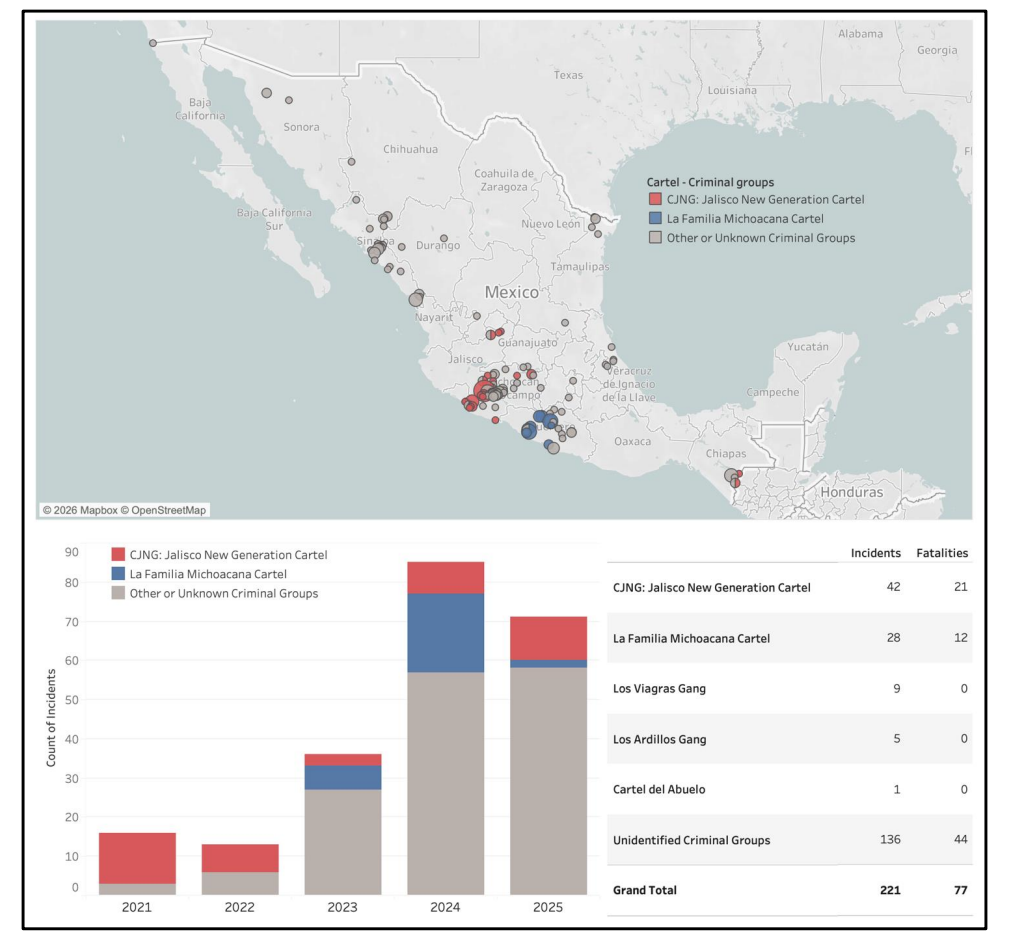
Mapping Weaponized Drone Attacks Attributed to Mexican Drug Cartels, NCITE Research Report, 2026.
The National Counterterrorism Innovation, Technology, and Education Center (NCITE), based at the University of Nebraska at Omaha, is an academic research center funded by the Department of Homeland Security. The program comprises more than 50 researchers and partner universities across the United States and Europe and aims to lead in the study of emerging terrorist threats.
Below are key takeaways from their latest report concerning drone employment by Mexican Cartels. Read the report alongside Small Wars Journal’s Drones and Border Cartels (Feb. 2026) and How Cartels are Adopting Drone Tactics from Ukraine (Jan. 2026) to see the threat picture in full focus!
Highlights from the NCITE Report
In 2025, the U.S. government designated six Mexico-based cartels as foreign terrorist organizations (FDTCOs), and the report links that move to concerns about escalating cartel UAS activity and its implications for U.S. homeland security.
Between 2021 and 2025, NCITE assessed 221 weaponized drone incidents in Mexico attributed to cartels or other criminal groups. 27 of those attacks resulted in fatalities, with a total of 77 killed. Weaponized drone attacks have been geographically concentrated in central Mexico (especially Michoacán and Guerrero) but have become more dispersed in recent years, including into border regions with the United States.
Using Armed Conflict Location and Event Data (ALCED), the report finds that CJNG is linked to 42 drone attacks from 2021 to 2025 and represents the largest share of attributed incidents (about 19%). La Nueva Familia Michoacana (LNFM) accounts for roughly 12.6% of attributed weaponized drone incidents over the same period. The dataset also includes 136 drone-related attack incidents attributed to unidentified cartel or criminal groups, so most incidents currently lack confirmed attribution.
FDTCO recorded violent drone incidents in Mexico, 2021 – 2025
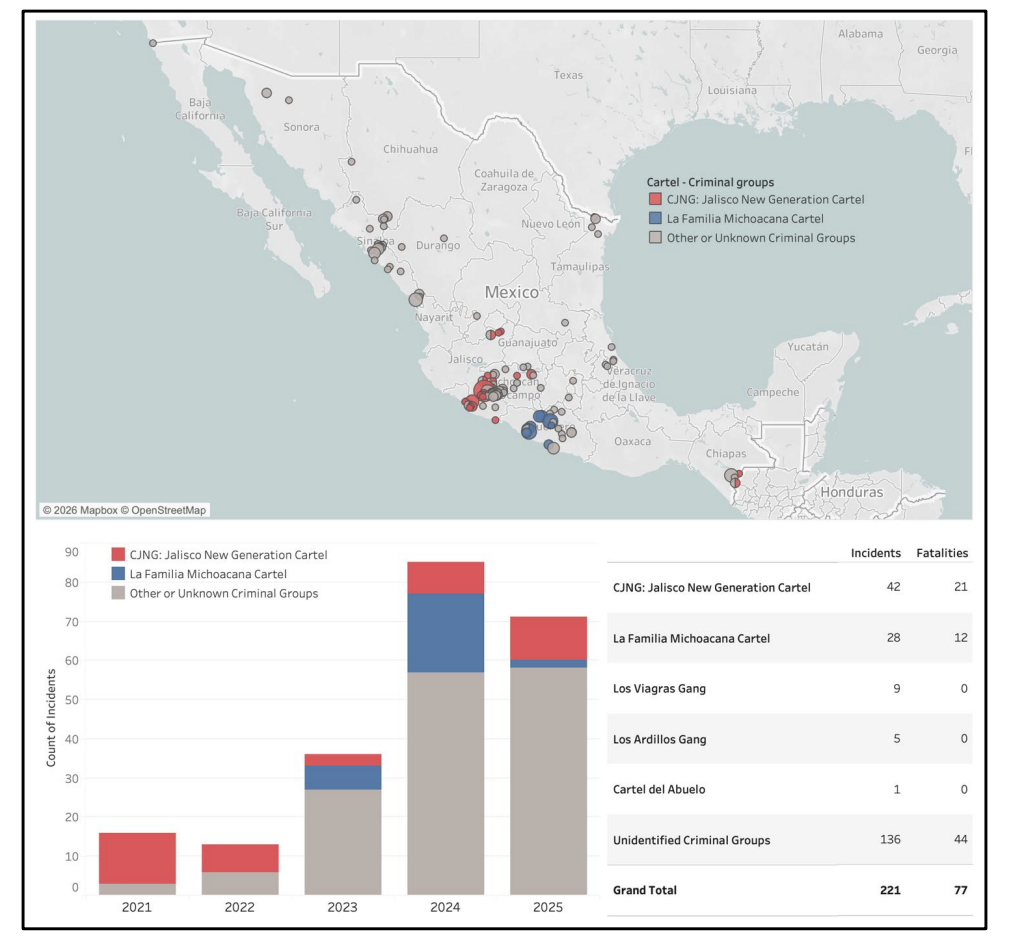
LNFM’s drone activity rose sharply from 6 recorded incidents in 2023 to 20 incidents in 2024, before dropping to 2 incidents in 2025. In 2024, 15 of LNFM’s 20 incidents occurred within a 72-hour period (March 22–24), during which the group reportedly deployed more than 20 explosive devices via drones across multiple regions.
The report also finds that cartels most often use weaponized drones against civilians, community defense forces, and rival groups, while attacks against police and military occur less frequently but appear to be increasing. Those weaponized drone attacks commonly involve air-dropped explosive payloads (such as grenades, munitions, or IEDs) delivered by small commercial drones. The report notes that CJNG even adopted more advanced techniques, including multi-munition drop systems, FPV drones that detonate on contact, and experimented with fiber-optic command-and-control.
The post Mapping Weaponized Drone Attacks Attributed to Mexican Drug Cartels appeared first on Small Wars Journal by Arizona State University.


Related Articles

Ticket Scam Cost the Louvre $12 Million, Investigators Say
The Paris prosecutor’s office said that a network involving museum employees and...
In Hungary, Marco Rubio Stresses Trump’s Support for Viktor Orban
The U.S. secretary of state said in Budapest that the president was...


Spain raises minimum wage to €1,221 per month
Spain’s Labour Ministry and the country’s leading trade unions on Monday agreed...
U.S. Deports Nine Migrants in Secret, Ignoring Legal Protections
Most had court orders protecting them from removal to their home countries,...
Leave a comment