





Is Goldman Sachs’ $153M XRP Exposure a Bull Signal for XRP, or Will $LIQUID Take Over?
What to Know:
- Reports about Goldman Sachs buying XRP ETFs are misinterpretations of filings; they show exposure to trust products, not yet-approved US spot ETFs.
- The trend highlights growing institutional interest in altcoins but also exposes the deep problem of fragmented liquidity across blockchains.
- LiquidChain aims to solve this fragmentation with a Layer 3 protocol that unifies liquidity from Bitcoin, Ethereum, and Solana.
- As institutional capital flows into siloed crypto assets, the need for robust cross-chain infrastructure is becoming more critical than ever.
Recent market chatter has exploded around filings suggesting major institutional players, including Goldman Sachs, are gaining exposure to XRP. $153M of it to be more specific.
The filings reflect holdings in existing trust products, as institutional capital carves out territory in assets like Bitcoin, Ethereum, and now XRP, our digital economy grows more powerful but also dangerously fragmented.
This matters because institutional adoption isn’t one big event; it’s a slow-burn process. First comes Bitcoin, then Ethereum, and now the market is testing the waters for other large-cap altcoins. Each new institutional product, whether it’s a trust or a future ETF, creates another silo of liquidity. Capital can flow into XRP, sure, but moving that value over to the Bitcoin or Solana ecosystem remains a complex, high-friction mess of wrapped assets and vulnerable bridges.
The market is cheering for mainstream validation while simultaneously building taller walls between its most important ecosystems.
What good is a multi-trillion-dollar market if its value is trapped on digital islands? This underlying tension is setting the stage for the next wave of innovation: foundational infrastructure designed to tear those walls down.
This is where LiquidChain ($LIQUID) makes its entrance.
The Problem Hiding Behind the Headlines
While the market focuses on which single asset will win the institutional race, the smarter question is how these assets will eventually interact.
An ETF for XRP would be a huge milestone, legitimizing it for a new class of investors. However, it does nothing to solve the chronic problem of fragmented liquidity that plagues decentralized finance (DeFi).
A portfolio manager holding $BTC via an ETF can’t easily deploy that capital into a Solana-based yield farm without a painful process of selling, wiring fiat, and re-buying on a separate chain. This is the fundamental friction holding DeFi back from true mainstream scale.
And that’s the exact challenge LiquidChain ($LIQUID) is engineered to solve. It operates as a Layer 3 protocol designed to be a cross-chain liquidity layer, fusing the liquidity of Bitcoin, Ethereum, and Solana into a single, unified environment. Instead of forcing developers to build separate dApps for each ecosystem, LiquidChain offers a ‘Deploy-Once Architecture.’
A protocol can be deployed just once while accessing users and capital from three of the largest blockchains simultaneously. For users, its ‘Single-Step Execution’ abstracts away the complexities of cross-chain swaps, making the multi-chain world finally feel like a single platform.
An Infrastructure Play for a Multi-Chain World
As institutional interest validates individual assets, the value of the underlying infrastructure that connects them grows exponentially.
This is where LiquidChain positions itself. It’s not just another DeFi application; it’s a foundational layer aiming to become the go-to plumbing for value transfer between major blockchains. The project is still in its early stages, offering a compelling entry point for those who see where the market is headed.
According to its official site, the LiquidChain presale has already raised an impressive $546k, with the $LIQUID token priced at just $0.0136.
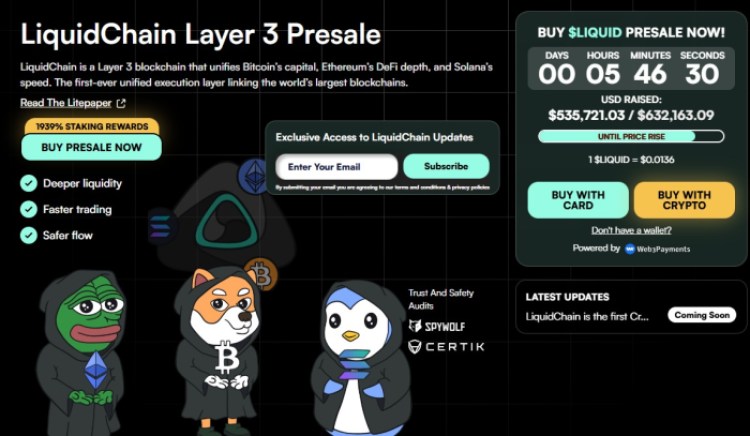
This kind of traction suggests a strong appetite for solutions addressing real, persistent problems. The project’s tokenomics are centered on utility, with $LIQUID used for liquidity staking rewards and as gas for transactions on the network. This creates a direct link between the growth of the LiquidChain ecosystem and the value of its native token.
While the market is distracted by the speculative buzz around which altcoin might get the next ETF, LiquidChain represents a more fundamental thesis: the ultimate winner won’t be a single chain, but the technology that unifies them all. For investors, this presents a ground-floor opportunity to get involved in a project building for the next generation of DeFi.
Disclaimer: This article is for informational purposes only and should not be considered financial advice. All investments, especially in presales, carry inherent risks.


Related Articles

Asia crypto regulation: Hong Kong to issue stablecoin licences as Malaysia tests Ringgit digital assets
Major financial hubs in Asia are stepping up regulated digital asset efforts...

Bitcoin Mogul Erik Voorhees Shifts Millions Into Gold as LiquidChain Presale Climbs
What to Know: Bitcoin’s rebound attempts are still flow-driven; recent US spot...

Google Cloud flags North Korea-linked crypto malware campaign
Mandiant, which operates under Google Cloud, has tracked the suspected North Korean...


Bitcoin Whales Quietly Scoop Up $4.7B in BTC, Pushing Bitcoin Hyper Into the Spotlight
What to Know: Bitcoin whales have added over $4.7B in $BTC, signaling...
Leave a comment