





Enabling Decision Dominance through Human-Machine Teaming
How the US Army Command and General Staff College Combine AI-related Skills with Military Fundamentals to achieve Cognitive Overmatch
Introduction:
Modern conflicts such as the ongoing war in Ukraine demonstrate the enduring necessity of technical adaptation Regional conflicts like Nagorno-Karabakh and Sudan provide contemporary examples of how quickly crisis can escalate into war with regional and global implications. Strategic leaders rely on officers across the Joint Force whose professional military education and operational experience enable them to inform commanders’ decisions. The pace of modern conflict demands the ability to provide “decision dominance” or “providing commanders the ability to assess the battlefield, make decisions, and apply lethal capabilities …[and] do it quicker than the enemy can do it.” To increase the speed of decision making, the US Army Command and General Staff College (CGSC) at Fort Leavenworth, Kansas, is expanding its digital toolbox with systems that offer opportunities for faster analysis, plans development, and automated execution processes through artificial intelligence (AI) and improved collaboration capabilities. In 2025, the Secretary of the Army directed the integration of AI into Command and Control nodes to accelerate decision making, reinforcing the educational modernization at CGSC.
As the Army’s “School for War” the Command and General Staff School (CGSS) is a school for applied warfighting and organizational leader development. It prepares field grade warfighters to plan, synchronize, and execute operations to win at the Joint and Combined Task Force, Corps, and Division levels through a curriculum that integrates data analytics, AI, and “system” thinking. CGSC provides its students with access to modern AI and collaborative tools in recognition of the need for adaptive officers to enable the planning process and provide commanders creative, data enabled solutions to complex challenges. In enabling its graduates, leading warfighters Day 1 at their next role, educational efforts through augmentation by teaming human capability, experience, creativity, and ethics, with machine capacity, the school provides experiences in keeping with its mission to educate and develop graduates who are “agile, innovative, and adaptive leaders within increasingly complex and uncertain environments.”
Student Transformation
Students attending the Command General Staff Officer Course (CGSOC) make many professional and personal transitions. CGSOC students represent a diverse cohort drawn from allied and partner nations, sister services, and the U.S. Army, bringing a wide range of operational experience. They grow into the role of Field Grade Officers from the realm of company command or direct leadership to organizational leadership and systems development combined with process management. CGSS enables that evolution by teaching students how to leverage the Joint Planning Process and the Military Decision-Making Process (MDMP) at the Combined Joint Task Force, Corps, Division, and Brigade levels.
To prepare for more demanding operational environments, CGSC introduces students to the ‘Complexity Toolkit,’ a framework for understanding and operating complex systems and environments. The toolkit encompasses data literacy, systems thinking, critical and creative thinking, and an initial understanding of (AI). The toolkit’s design enables students to better understand the operational environment to support commanders’ decision making. The foundational common core set of courses further exposes the students to the broader responsibilities of military planners and combat leaders. These include classes taught by experts with experience in examining strategic environments, international systems, and the US National Security Apparatus. Concurrently, students dive deep into their future responsibility as warfighters: applying Multi-Domain Operations the Joint Warfighting Concept, and Joint All Domain Operations. These concepts and their application are reinforced through planning exercises in modern operational environments. The exercises give students the opportunity to lead the Joint Planning Process (JPP) Army Design Methodology (ADM), and MDMP.
Models to Assist in Development
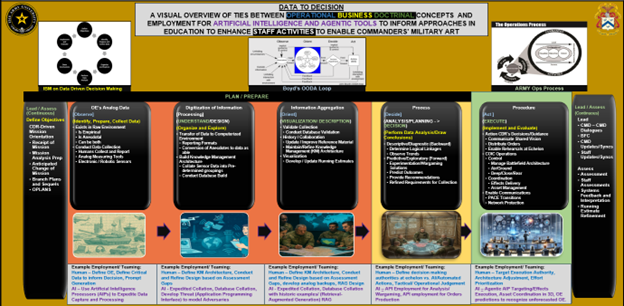
Many academic and military models such as IBM’s Data Driven model, John Boyd’s Observe, Orient, Decide, Act Loop (OODA), and the Army’s Operations Process aid in problem framing and enabling the transition from planning for more discrete and simplified environments to broad chaotic, and increasingly complex environments. These models also tie to commanders’ activities to understand environments and options, then visualize, describe, direct, lead, and assess operations. Visualized in Figure 1 below, overlaying models show how organizations can amplify the speed of processes using operational, business, and doctrinal concepts – with specific use cases including the new lexicon for AI.
Using these models helps instructors identify the skills required to employ AI and agentic tools effectively in both education and operations. Naming risks like Large Language Model (LLM) or Machine Learning biases, understanding Retrieval Augmented Generation (RAG) enables students to seek opportunities to best build and manage AI-enabled tools, agent, or planning assistants such as AI Processors (AIP) or develop Application Programming Interfaces (API). This allows instructors to focus on human and machine teaming approaches to enhance staff activities. Successful human-machine teaming allows humans to focus on the creative end and use AI tools to automate or speed up the repetitive. Taking advantage of both human and machine strengths provides results such as faster execution of staff activities and integration, improved or automated coordinating product generation, and reduction of cognitive overload in data-saturated environments.
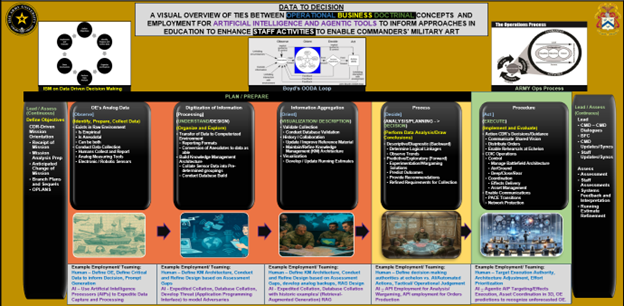
Figure 1 – A visualization of employment of AI’s augmentation in operations – designing data use to inform decision. Pictures within arrow flow of visualization generated using AI generators (Gemini, Ask Sage).
Solid Foundations, Simultaneous Scaffolding
Before accelerating any approach, instructors must facilitate foundations for students’ planning processes and apply sound principles. Often described as the “science” side of military planning – students require sound foundation in the various processes, before AI can be effectively used to make the process more efficient. Students examine current Joint and U.S. Army doctrine as the foundation for effective military planning, while exploring history, leadership case studies, and force management.
Importantly, instructors and students understand a key fundamental of systems, that “garbage in, equals garbage out.” Just as an unchecked or inexperienced planner on a staff could create an outsized negative result with an undisciplined process, so too could an AI. Before accelerating planning with AI tools, students must understand their teams and processes. The quality of the user’s prompt generation, LLM design and references, and RAG definition limit the effectiveness of augmentation through AI. Students and graduates must understand the design of their augmentation well enough to identify potential “drift,” “hallucination”, or other unintended outputs. Separately, better understanding of AIP/API development can enable more efficient use of AI tools, reducing the processing costs associated with poorly designed ontologies.
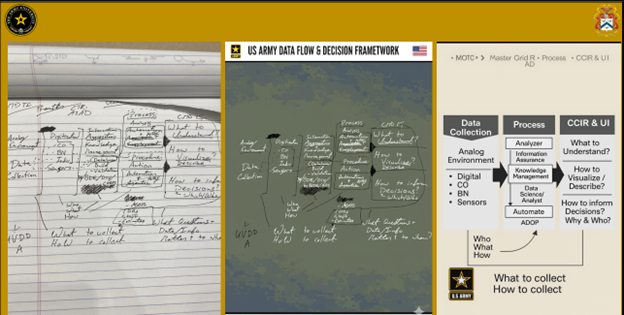
Figure 2 – Example of how planners can use AI but must review to avoid hallucination. Seen here in two AI-produced visuals based on initial human mind-mapping (Left- Human Drawn. Center – Chat GPT 5.0, Right- Gemini).
Instructors introduce both military and commercial AI early in the academic year to ensure students can practice with the various AI agents according to their individual preferences. Students begin experimenting with AI at varying levels of ability, gradually developing their own agents while sharing insights about both its strengths and limitations. AI then goes from a rarely used tool on the shelf to everyday use as the students became more comfortable with using it. As the courses progress from initial exercises to culminating exercises, instructors shift the emphasis on AI-use in the classroom from describing hypothetical potential uses, to simple pairing of simple AI skills with specific planning process steps, to designing RAGs, developing custom AIPs, and using other AI tools to enhance their planning efforts.
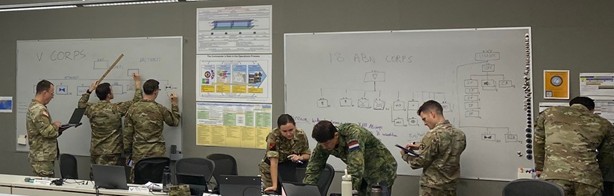
Figure 3 – CGSC Students explore and define US Army capabilities with board visuals and early AI tools.
Exploration and Results:
While tackling operational problem sets during an exercise, students developed their AI projects to help individual and group efforts navigate the exercise. The projects provide examples of how augmentation could enable Information Advantage, a core requirement in Multi-Doman Operations. The students employed AI and collaborative tools including Notebook LM, Vantage, Ask Sage, Rev, and Onebrief. Their work produced a range of AI-enabled tools focused on the following areas: 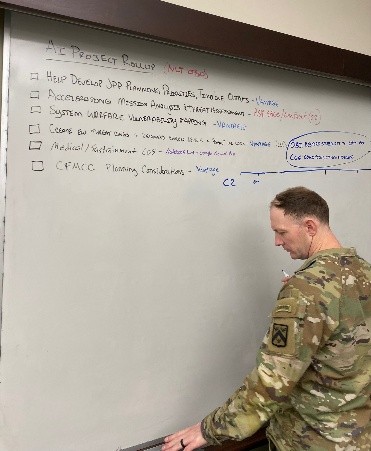
- Planning Timeline and Prioritization
- Mission Analysis and Threat Assessment
- Medical and Sustainment Concept of Support
- System Warfare Vulnerability Analysis and Mapping
- JPP Planning Priorities and Key Outputs
- Maritime Operational Planning Factors and Considerations
- Tactical Wargaming Analysis and Product Generation
- Electromagnetic Threat and EMCON Analysis Tools
Each project supports the rapid synthesization of information across a joint force. Affording more time for further human analysis and less focused purely on processing data for later analysis. For example, using the System Warfare Vulnerability Analysis and Mapping project, students mapped adversary center of gravity and critical capabilities. This highlighted interdependencies that revealed exploitable critical vulnerabilities.
The AI agent sharpens the joint planning group’s understanding of the adversaries Center of Gravity, “which is the source of power that provides moral or physical strength, freedom of action, or will to act.” The agent identified critical capabilities, requirements, and vulnerabilities across linked systems, enabling the planning team to maintain the initiative throughout the operation. Using a system-analysis and systems warfare perspectives, the joint planning group mapped how those critical factors interact and where friendly actions can potentially have significant and disruptive effects. This allowed the human analysts to make well informed, data enabled decisions to attack the critical vulnerabilities within the critical requirements that would degrade enemy combat power if disrupted.
Throughout CGSC and in more complex exercises, students will experiment with collaborative tools, augmented by AI for course of action development, mission and course of action analysis, with the goal of expediting orders production. Fundamentally, students look to improve the speed at which they can facilitate military decision making. In the future, in more challenging problems they will approach using Multi-Domain Operations to win at the Joint Task Force, Corps, Division, and Brigade level. CGSC graduates will lead in the force, practiced in the fundamentals of military planning and well-versed in employing the complexity toolkit, including AI, to enable commander decision dominance across the conflict continuum.
Conclusion:
As US forces rapidly evolve the combat capabilities of US military formations to meet the challenges of tomorrow, so equally must CGSC elevate the pace at which graduates can understand warfighting conditions and adapt to win in all environments. CGSC is responsible for developing adaptive leaders who can operate at the decision-making tempo required for success on the modern battlefield. Instructors assume the ability to integrate AI, through successful human-machine teaming, into staff planning to be both necessary and unavoidable to best enable students’ ability for future assignments. This makes the current moment a pivotal opportunity to enhance professional military education with emerging technologies and give opportunities to build experience and best practices for the future. By adapting curriculum for collaborative technologies and AI integration in the Joint and Army operational contexts, CGSC empowers its graduates to lead in a data-centric environment, equipped to achieve decision dominance at a pace to outmatch adversaries and win.
The post Enabling Decision Dominance through Human-Machine Teaming appeared first on Small Wars Journal by Arizona State University.

Related Articles
Engaging Rwanda: A Pragmatic Approach To The Great Lakes Conflict
The 2012 rise of the Mouvement de Mars 23 (M23) as a...


Doha Forum 2025 live: Gaza, Ukraine wars in focus as policy leaders gather
World leaders, high-level diplomats and business executives take part in annual platform...
Palestinian groups express ‘grave concerns’ over Marwan Barghouti’s safety
Palestinians express alarm following ‘intimidating’ call to family of imprisoned leader alleging...
Canada removes Syria from list of states that support ‘terrorism’
Ottawa cites similar move by US as well as Syrian government’s efforts...
Leave a comment