



Identifying Santa Muerte Symbolic Vulnerabilities for Counter-Narco Communications
Why do criminal organizations embedded in violent and illicit economies incorporate a folk saint into their symbolic repertoire rather than rely solely on fear, money, or coercion? Across the internet, narratives surrounding Santa Muerte often referred to by devotees as La Niña Blanca (the White Girl). A skeletal female figure venerated as a supernatural intercessor. Devotion to the Santa Muerte circulates in prayers, songs, personal testimonies, and rituals that describe protection, justice and, survival in environments marked by institutional failure.[1] While the vast majority of Santa Muerte devotees are not involved in criminal activity, prior research has shown that drug cartels and affiliated actors have selectively appropriated this belief system into narco-culture where it functions as a legitimizing and motivational component of cartel propaganda rather than a benign form of folk religiosity.[2]
Narcocultura (narco-culture) refers to the network of symbols, narratives, aesthetic forms, and moral logics that normalize and make sense of life under conditions shaped by drug trafficking and organized crime. In this context, Santa Muerte does not operate primarily as theology or doctrine, but as a narrative system. A set of recurring story forms that explain crisis, authorize violence, normalize risk, and bind obligation to perceived supernatural protection. Despite growing scholarly attention to Santa Muerte’s history and social reach, the specific narrative genres through which her narco-cultural variant is sustained and reproduced remain largely unmapped.[3] This article addresses that gap by systematically analyzing devotee-generated digital narratives to identify the dominant story forms mobilized within cartel-adjacent Santa Muerte discourse. Also to assess the symbolic vulnerabilities these narratives introduce for counter-narco communications.
Narco-culture does not rely on violence alone to normalize criminal authority; it relies on stories that render violence intelligible, justified, and even necessary within a moralized (and at times amoralized) worldview. Scholars of narcocultura have shown that criminal organizations sustain legitimacy through cultural production, music, imagery, ritual, and myth, that frames illicit actors as protectors, providers, and agents of justice rather than predators.[4] Religious symbolism becomes especially potent within this ecosystem because it supplies transcendental meaning to otherwise instrumental violence, transforming risk, death and sacrifice into signs of destiny rather than consequence.[5] Santa Muerte’s cartel-adjacent variant draws strength from this cultural logic by embedding criminal action within repeatable narrative forms that explain why devotion “works” when the state, law, or church does not.[6] Understanding Santa Muerte’s role in narcocultura therefore requires shifting analytic attention away from isolated symbols or rituals and toward the narrative genres that organize experience, authorize behavior, and transmit belief across digital environments.[7] It is these narrative structures, rather than belief per se, that allow cartel-appropriated Santa Muerte discourse to persist, adapt and scale without centralized authority. Accordingly, this study shifts analytic attention from symbols or beliefs in isolation to the narrative genres through which cartel-adjacent Santa Muerte discourse organizes crisis, assigns moral agency, and stabilizes meaning across digital environments. Genres that function as shared cultural scripts rather than idiosyncratic acts of faith.
Narrative Genres as Cultural Infrastructure in Narco-Cultural Discourse
Narratives are not merely retrospective accounts of experience. They are structured mechanisms through which individuals and groups interpret crisis, assign responsibility and determine appropriate courses of action. Research across sociology, psychology and communication demonstrates that narratives operate as patterned forms. Organizing events into recognizable sequences that render uncertainty manageable and morally intelligible.[8] When such patterns stabilize and recur, they coalesce into narrative genres. These are repeatable story types that can be learned, imitated and circulated independent of any single author or authority.[9] In cartel-adjacent Santa Muerte discourse, these genres function as cultural infrastructure. They translate danger, illegality and violence into coherent scripts of protection, justice, obligation and survival that resonate within narcoculture.[10]. Focusing on narrative genre therefore allows this study to move beyond individual belief claims or symbolic artifacts by identifying the underlying story structures that normalize criminal risk, legitimize cartel behavior and enable the digital reproduction of Santa Muerte’s narco-cultural variant across platforms.[11]
Building on this framework, the present study treats narrative genres as empirically observable patterns rather than abstract interpretive claims. Genres are identified through recurring configurations of crisis, agency, moral evaluation and outcome that appear consistently across Santa Muerte. This includes related digital texts, regardless of platform or individual speaker. Prior ethnographic work on Santa Muerte has documented the centrality of testimony, miracle accounts, and experiential storytelling in sustaining devotion.[12] Particularly among populations exposed to chronic risk and marginalization. What remains underexplored are how these stories stabilize into a limited number of repeatable narrative forms that can be readily appropriated by narco-cultural actors.[13] By analyzing narratives at the level of genre rather than belief sincerity or ritual correctness, this approach avoids pathologizing individual devotees while making visible the specific story structures through which cartel-adjacent discourse operates. This shift enables systematic comparison across narratives and provides a basis for identifying which genres are most compatible with narcocultura and thus most relevant for strategic analysis.[14]
Identifying Narrative Genres in Cartel-Adjacent Santa Muerte Discourse
To identify narrative genres within cartel-adjacent Santa Muerte discourse, this study adopts a discourse-centered approach that treats recurring story structures as socially produced patterns. Analyzing discourse at this level allows researchers to examine how power, legitimacy, and moral meanings are constructed collectively through language.[15] Prior scholarship on Santa Muerte has demonstrated that narratives of protection, justice, and survival vary significantly depending on social context. Particularly when devotion is appropriated by criminal actors operating in high-risk environments.[16] Narrative genre analysis makes these variations comparable by isolating shared structural elements. For instance, crisis triggers, moral justification, agentive intervention, and outcome that recur across otherwise diverse testimonies. This approach is consistent with broader findings in narrative criminology, which show that illicit actors rely on stable story forms to normalize violence, manage risk and sustain identity under conditions of threat and illegality.[17] By focusing on genre-level regularities, the analysis reveals which narrative forms are most compatible with narcoculturaand therefore most consequential for understanding how Santa Muerte discourse functions as a cultural resource within cartel-associated environments.
To identify narrative genres the analysis examined complete narrative episodes rather than isolated symbols, ritual instructions or expressions of belief. Genres were delineated inductively but guided by established narrative-analytic practice. The focus is on recurring configurations of four structural elements. First a crisis trigger that disrupts normal order followed by an agentive intervention that restores control. Third a moral logic that justifies action and finally an outcome that resolves uncertainty or imposes obligation.[18] Only narratives containing a full sequence from disruption through resolution were coded as genre instances. Allowing systematic comparison across otherwise heterogeneous testimonies and platforms. This structural approach distinguishes genre from theme or sentiment by treating narratives as patterned sense-making devices that organize experience and authorize behavior under conditions of risk and illegality.[19] Applying these criteria yielded a limited set of dominant narrative genres that recur consistently within cartel-adjacent Santa Muerte discourse. Ones that function as transferable cultural scripts rather than idiosyncratic personal accounts.[20] The sections that follow present these genres in order of their centrality to narcocultura.
This study is guided by two research questions that distinguish between the narrative structures embedded in cartel-adjacent Santa Muerte discourse and the ways those structures are recognized or contested by audiences.
RQ1 asks: What recurring narrative genres structure cartel-adjacent Santa Muerte discourse across digital texts, and how do these genres organize meanings of protection, justice, obligation, and survival within narcocultura?
RQ2 asks: How do user comments associated with this content reflect recognition, reinforcement, or contestation of the identified narrative genres?
Methods
This study employs a structured, multi-stage analytical procedure designed to translate symbolic systems into analyzable empirical components. The analysis proceeds in three sequential phases. First, relevant texts were collected and prepared as a unified corpus for analysis. Second, theoretically derived symbolic and narrative features were operationalized as discrete analytical variables and systematically identified within the corpus using a combination of structured coding rules and computational assistance. [21]. Third, quantitative techniques were applied to examine the distribution, co-occurrence, and relational patterns of these features across the dataset. This design allows symbolic structures to be analyzed with methodological transparency while retaining sensitivity to meaning, narrative function, and cultural context.[22]
Variables and Measures
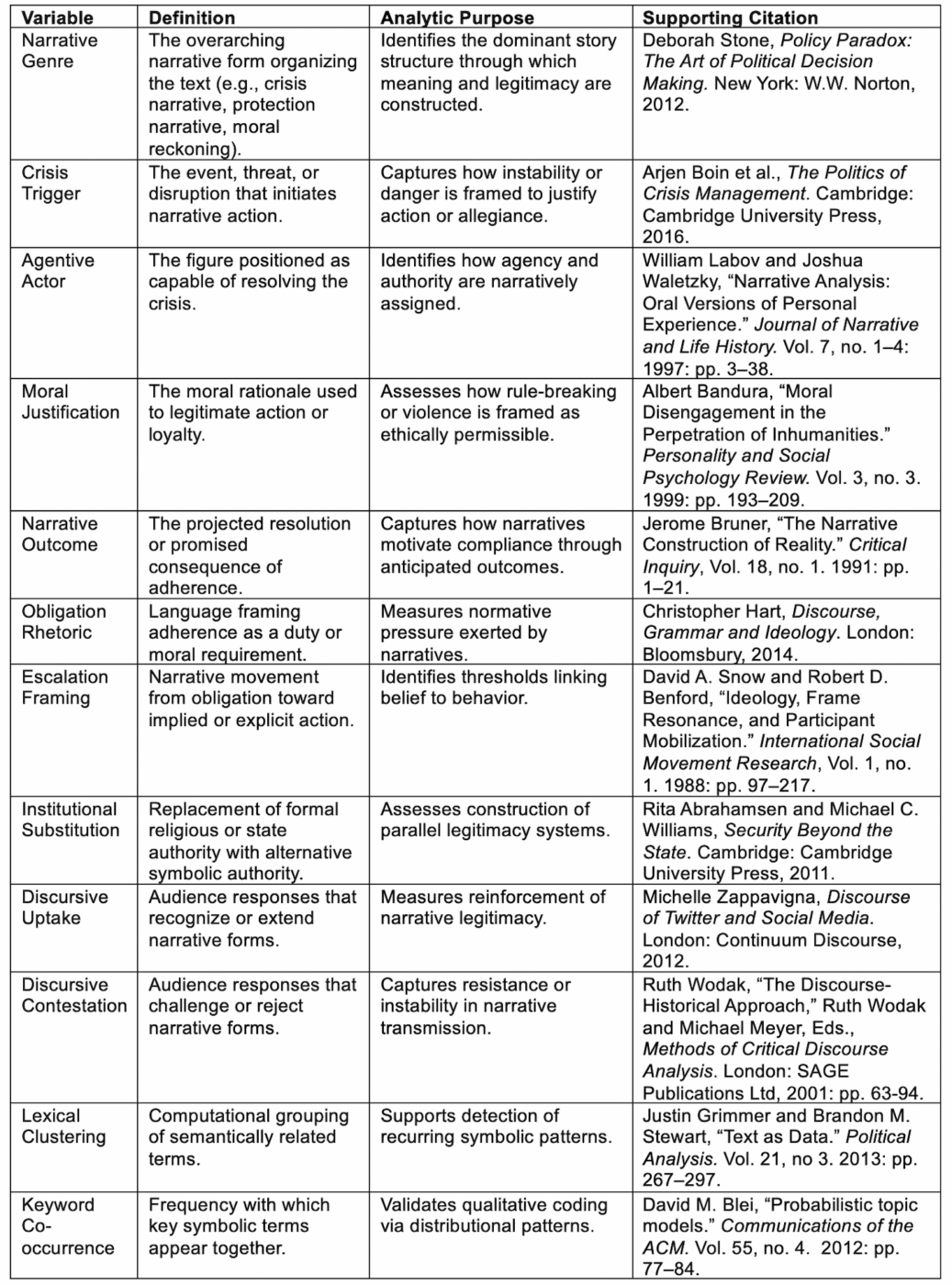
Analytic variables were deductively derived from narrative theory, symbolic systems analysis, and scholarship on legitimacy construction in illicit governance contexts. Each variable captures a distinct narrative or symbolic function rather than surface-level thematic content and was operationalized using explicit coding rules to ensure consistent identification across texts and to permit subsequent quantitative analysis.[23] Table One summarizes all analytic variables used in the study, including their definitions, analytical roles, and supporting sources. To assess how narratives frame authority and legitimacy, additional variables captured obligation, escalation, and institutional substitution, reflecting how moralized narrative structures are used to stabilize action and justify rule-breaking behavior in illicit and violent contexts. Variables applied to user comments focused on discursive functions. For instance, recognition, reinforcement, correction and contestation, which allow analysis of how narrative genres are taken up, negotiated or resisted by audiences without treating commenters as a representative population.[24] Finally, computational text analysis variables, including lexical clustering and keyword co-occurrence, were used to support pattern detection and to validate qualitative coding, consistent with methodological guidance emphasizing the complementary use of NLP (natural language processing) in interpretive research rather than their use as standalone explanatory tools.
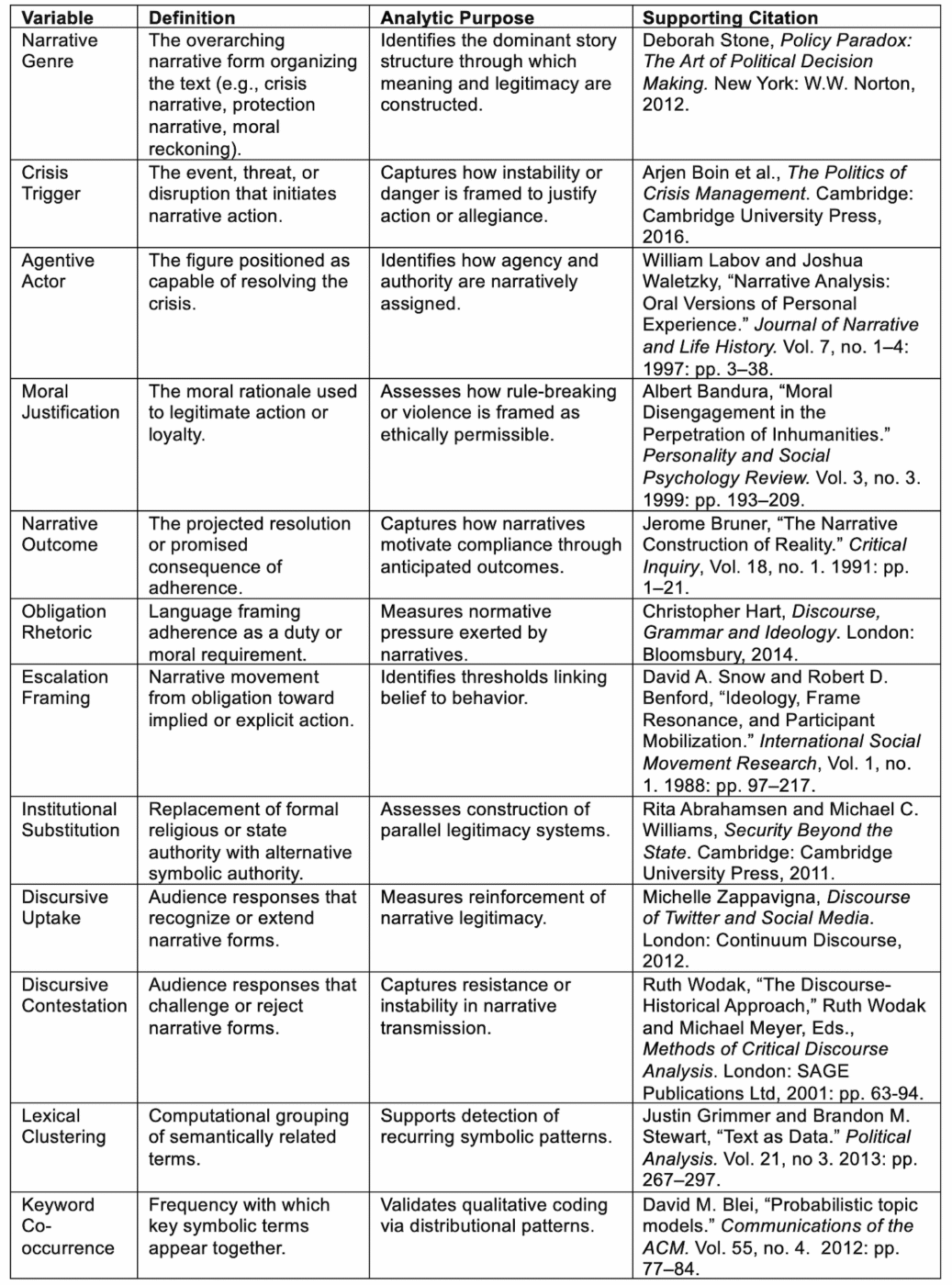
Table 1. Analytic Variables and Operational Definitions
Statistical Procedures and Analytical Metrics
Quantitative analysis was used to examine the distribution and relational patterning of the analytic variables defined in Table One. Because the study is oriented toward identifying symbolic and narrative structures rather than estimating population parameters, analyses were descriptive and relational rather than inferential. Frequency counts were used to assess the prevalence of narrative genres, authority frames, and discursive functions across the corpus, while co-occurrence analysis examined recurring alignments among narrative features, moral justifications, and institutional substitutions within individual texts. Cross-tabulation and correlation-based measures were employed to identify patterned associations between narrative genres, crisis triggers, agentive actors, and projected outcomes.[25]
Computational outputs from lexical clustering and keyword co-occurrence analysis were used to support pattern detection and to corroborate manually coded relationships, particularly where symbolic configurations recurred across texts. These computational measures were not treated as standalone explanatory models but as complementary tools integrated into the broader interpretive framework. All statistical results are reported in terms of frequencies, proportional distributions, and relational patterns; no claims of causal inference or population generalization are made, and quantitative findings are interpreted solely as indicators of symbolic structure and narrative organization within the analyzed corpus.[26]
Coding Workflow and Analytical Tools
Coding followed a structured, hybrid workflow combining rule-guided qualitative analysis with computational support. Analytic variables were coded using explicit definitions and decision rules derived deductively from theory and summarized in Table One. Texts were first reviewed to identify narrative structures, authority frames, and discursive functions at the level of narrative function rather than surface theme. This coding was applied consistently across the corpus to ensure comparability prior to quantitative analysis.
Computational tools were used to support coding consistency, pattern detection, and validation rather than to automate interpretation. Text preprocessing, lexical clustering, and keyword co-occurrence analysis were conducted using standard text analysis software to identify recurring symbolic configurations and to corroborate manually identified patterns. Computational outputs were reviewed in relation to the coded variables and used to flag convergence, divergence, or recurrence across texts. This hybrid approach allowed symbolic interpretation to remain theoretically grounded while improving transparency, consistency, and analytical rigor.
Findings
Analysis of the corpus reveals a small number of recurring narrative patterns that organize cartel-adjacent Santa Muerte discourse across multiple forms of digital expression. A finite set of five dominant narrative genres emerged that recur consistently across texts. Indicating that narco-cultural appropriation of Santa Muerte relies on a limited repertoire of repeatable story forms rather than idiosyncratic belief expressions. User comment activity was unevenly distributed across texts but consistently engaged with narrative content, including affirmation, reinterpretation, correction and contestation of the stories presented. Taken together, these findings suggest that the identified narrative genres function not only as production templates for cartel-adjacent discourse but also as recognizable cultural scripts that are actively reinforced and negotiated by audiences. The sections that follow present the narrative genres in order of their functional centrality to narcocultura and describe how each genre structures meaning, obligation, and legitimacy within cartel-adjacent Santa Muerte discourse.
Research Question One
The first research questions asks: What recurring narrative genres structure cartel-adjacent Santa Muerte discourse across digital texts, and how do these genres organize meanings of protection, justice, obligation, and survival within narcocultura? Addressing RQ1, analysis identified five recurring narrative genres that structure cartel-adjacent Santa Muerte discourse.
Descriptively, Guidance/Relationship narratives were most prevalent (40.0%), followed by Protection/Deliverance (30.0%), Transactional Prosperity (15.0%) Healing/Relief (12.5%), and Justice/Retribution (2.5%). Beyond frequency, genres were structurally differentiated in systematic ways. Narrative genre was significantly associated with crisis trigger, χ²(24, N = 40) = 39.95, p = .022, Cramér’s V = .50, indicating that genres were unevenly mobilized across threat conditions. Significant associations were also observed between genre and moral logic, χ²(24, N = 40) = 103.26, p < .001, Cramér’s V = .80, and between genre and outcome type, χ²(24, N = 40) = 95.03, p < .001, Cramér’s V = .77, demonstrating that each genre carried a characteristic configuration of justification and resolution rather than functioning as a loose thematic label.
Qualitative analysis illustrates how the most prevalent genres operate as concrete narrative structures rather than abstract belief claims. Guidance/Relationship narratives depict Santa Muerte as a continuous relational presence who offers direction, reassurance and companionship amid instability. These narratives emphasize attentiveness and loyalty over transactional exchange. They frame devotion as an ongoing relationship rather than a single request. One video testimony describes this relational framing directly: “She walks with me every day. I talk to her like family, and she listens when no one else does”. Protection/Deliverance narratives, by contrast, center on moments of acute threat, such as violence, arrest, or betrayal and portray Santa Muerte as an intervening protector who actively ensures survival or escape. A prayer text recounts this interventionist role: “Holy Death, you covered me when danger was close and guided me away from harm”. Transactional Prosperity narratives frame devotion as an explicit exchange, linking offerings, rituals, or vows to material gain, success or protection. In these accounts, Santa Muerte is depicted as reliable but conditional, as reflected in a song lyric stating, “I gave you what I promised, and you gave me what I asked for”.
The remaining genres further demonstrate how narrative structure adapts Santa Muerte symbolism to environments shaped by risk and illegality. Healing/Relief narratives focus on alleviating physical suffering, emotional distress or existential exhaustion. They often emphasize endurance rather than miraculous cure. One personal testimonial frames relief in terms of persistence: “She didn’t take the pain away, but she gave me the strength to keep going”. Justice/Retribution narratives, though comparatively rare, position Santa Muerte as an arbiter who restores moral balance by punishing betrayal or wrongdoing. These narratives translate grievance into moral accounting, as illustrated by a comment embedded in a video transcript: “Those who crossed me will answer to her, because justice always comes”. Across all five genres, these quotations demonstrate that cartel-adjacent Santa Muerte discourse relies on a limited set of repeatable narrative templates that render danger, obligation and uncertainty intelligible and survivable.
Research Question Two
Research Question Two asks: How do user comments associated with this content reflect recognition, reinforcement, or contestation of the identified narrative genres? We assessed whether each comment aligned with one of the five identified narrative genres. Unfortunately, 48.2% of comments could not be assigned to a narrative genre and were omitted from the results. Overall, 40.6% of analyzable comments were genre-aligned, indicating that a substantial portion of audience discourse engaged the content using the same narrative templates identified in the primary texts. Comment function was strongly associated with genre alignment, χ²(5, N = 251) = 90.03, p < .001, Cramér’s V = .60. Among genre-aligned comments, alignment was most common with Guidance/Relationship (n=20.7) and Healing/Relief (26.5%), followed by Transactional Prosperity (12.7%) and Protection/Deliverance (9.8%). However, Justice /Retribution alignment was not observed. The distribution of comment functions across these genre categories was not statistically significant, χ²(15, N = 102) = 12.80, p = .618, Cramér’s V = .20, suggesting that while function strongly predicts whether comments engage genre structures at all. Audiences use broadly similar discursive functions across the dominant genre targets.
Qualitative analysis of user comments demonstrates that audiences actively engage Santa Muerte content through recognizable narrative practices rather than passive affirmation. Re-narration was the most common form of engagement. Commenters frequently contributing their own abbreviated stories that mirrored the narrative structures of the source material. These comments often restated crisis–intervention–outcome sequences in compressed form. For instance, one comment stated: “She protected me too when I thought I wasn’t going to make it”. Such responses indicate that viewers do not merely consume narratives but reproduce them using the same genre templates identified in the primary texts. Correction and gatekeeping comments further reveal that audiences actively police narrative boundaries, reinforcing what counts as legitimate devotion or proper framing. For example, another commenter cautioned others by stating, “You can’t ask her for things and then disappear—this is a commitment”, echoing obligation escalation themes present in Guidance/Relationship and Transactional Prosperity genres.
Other comments reflect recognition and reinforcement of genre-specific meanings without adding new narrative material. These comments typically acknowledged the narrative logic of the video or prayer, as in “That’s how she works—she guides you when you’re lost”, signaling shared understanding of relational framing. Contestation, while comparatively rare, demonstrates that not all viewers accept the dominant narratives uncritically. Some comments challenged transactional or justice-oriented framings, such as “She isn’t about revenge, people misunderstand her”, indicating selective resistance to particular genre interpretations. Taken together, these qualitative patterns show that user comments function as a secondary discursive arena in which narrative genres are reiterated, corrected, or resisted, reinforcing their role as shared cultural scripts rather than isolated expressions of belief.
Discussion
This study demonstrates that cartel-adjacent Santa Muerte discourse operates as a structured symbolic environment sustained by a small number of stable narrative genres. These genres function as repeatable templates that organize how danger, obligation, justice and survival are interpreted under conditions of illegality and violence. The convergence of production (RQ1) and audience reinforcement (RQ2) indicates that these narratives are not merely expressive but infrastructural. They provide shared scripts that stabilize meaning and legitimize action in contexts where formal institutions are perceived as absent, hostile or unreliable. For information warfare practitioners, this finding reframes Santa Muerte from a cultural or religious phenomenon into a targetable symbolic system. One whose influence derives from narrative coherence and repetition rather than doctrinal belief. The implication is that effective counter-efforts should focus less on confronting devotion directly and more on disrupting the narrative genres that make cartel-adjacent uses of Santa Muerte intelligible, credible and socially reinforced.
Information Warfare Implications
Identified narrative genres expose distinct points of symbolic vulnerability that can be systematically targeted through information warfare focused on narrative coherence rather than belief confrontation. Guidance/Relationship narratives depend on perceived consistency, attentiveness and reciprocity. They are most effectively contested by amplifying stories of abandonment, silence or contradictory guidance that fracture the expectation of reliable relational presence. Protection/Deliverance narratives rely on demonstrable success at moments of acute risk. This creates a vulnerability to counter-framing that foregrounds non-intervention, arbitrary harm, or survival attributed to chance, personal action or external support rather than supernatural protection.
Transactional Prosperity narratives are particularly susceptible to symbolic disruption through exposure of failed reciprocity, escalating obligations or asymmetries between sacrifice and outcome. Introduce doubt into the exchange logic that underpins narrative credibility. Healing/Relief narratives, while less coercive, depend on endurance framing that renders suffering meaningful. These can be weakened by narratives that emphasize prolonged pain without resolution or question the moral logic of endurance without improvement. Finally, Justice/Retribution narratives hinge on moral attribution and perceived fairness, making them vulnerable to reframing strategies that highlight misdirected punishment, collateral harm or outcomes that contradict claims of moral balance. Across all genres, these approaches share a common logic: symbolic influence erodes when narrative expectations fail repeatedly and visibly. From an information warfare perspective, degrading Santa Muerte’s cartel-adjacent influence therefore requires sustained pressure on the internal narrative logic of these genres rather than direct attacks on faith, identity, or devotion itself.
An additional avenue for information warfare lies in displacing the symbolic authority that cartel-adjacent Santa Muerte narratives claim to monopolize. Many of the identified genres function by positioning Santa Muerte as a uniquely capable intermediary, able to provide protection, justice, guidance or endurance when other institutions are perceived as absent or illegitimate. Information efforts can weaken this position by gradually elevating alternative sources of symbolic authority that plausibly address the same needs. For instance, familial obligation, community solidarity, lawful reciprocity or widely recognized devotional figures that emphasize restraint and collective responsibility. The objective is not to delegitimize Santa Muerte outright, but to reduce its perceived exclusivity by demonstrating that protection, meaning and moral order can be derived from multiple symbolic frameworks. Over time, this form of symbolic competition erodes dependence by reframing Santa Muerte as one option among many rather than a necessary conduit for survival, thereby diminishing the narrative leverage that sustains its cartel-adjacent influence.
A third information warfare approach involves inflating and stress-testing the expectations embedded within cartel-adjacent Santa Muerte narratives. Each of the identified genres relies on tacit performance thresholds, reliable guidance, timely protection, fair reciprocity, meaningful endurance or just outcomes. These are only sustainable only when claims remain implicit and anecdotal. Information efforts can exploit this dependency by subtly foregrounding the logical implications of genre promises when generalized. For example, what does consistent protection, guaranteed reciprocity and universal justice mean when applied broadly rather than selectively. By drawing attention to moments where outcomes fall short, remain ambiguous or contradict genre expectations, without asserting deception or bad faith, these narratives are pressured to meet standards they cannot reliably satisfy. Over time, repeated exposure to unmet or uneven expectations introduces cognitive friction between promise and experience, weakening narrative credibility through internal strain rather than external attack. In this way, symbolic influence degrades not because belief is challenged, but because the narrative system is compelled to carry more explanatory weight than it can sustain.
A fourth information warfare approach targets the comment and interaction layer where narrative norms are enforced rather than the primary content itself. Findings from the comment analysis show that narrative genres are sustained primarily through re-narration and correction/ narrations and correction/gatekeeping. This suggests that two concrete avenues for execution are viable. First, re-narration can be disrupted by introducing parallel attribution in comment threads that recount protection or guidance (e.g., noting coincident factors such as timing, third-party assistance or personal decision-making alongside the experience), which interrupts the automatic reproduction of genre logic by diffusing exclusive symbolic causality without denial. Second, gatekeeping can be weakened by normalizing plural interpretations where commenters enforce obligation or transactional norms, inserting mild, non-confrontational alternatives that emphasize variability in practice or non-conditional devotion. This raises the social cost of correction and reduces the community’s capacity to police a single “proper” frame. Together, these actions directly target the two comment functions most responsible for genre maintenance, lowering the efficiency of narrative self-repair while avoiding overt confrontation.
Conclusion
This study demonstrates that cartel-adjacent Santa Muerte influence is sustained not by diffuse belief or theological commitment but by a small, repeatable set of narrative genres that organize how danger, obligation, justice, and survival are interpreted under conditions of illegality and violence. These genres function as symbolic infrastructure: they stabilize meaning, legitimate action, and are actively reproduced and enforced by audiences across digital spaces. By showing that both content producers and commenters rely on the same narrative templates, the analysis identifies Santa Muerte not as an intractable cultural phenomenon but as a coherent narrative system whose influence is contingent on structural consistency and reinforcement. For information warfare, this distinction is decisive. Symbolic power that depends on narrative coherence can be weakened through sustained disruption of genre expectations rather than confrontation of belief itself. Understanding how these narratives are constructed, circulated, and policed provides a foundation for counter-efforts that are precise, ethically restrained, and strategically effective. More broadly, the findings illustrate how illicit symbolic systems persist in contested environments—and how narrative analysis can expose their underlying vulnerabilities without collapsing cultural practice into criminal intent.
Endnotes
[1] Douglas Wilbur, “Employing Information Operations to Challenge Cartel (Narcocultura) Derived Santa Muerte Propaganda.” Small Wars Journal. 21 April 2025, https://smallwarsjournal.com/2025/04/21/employing-information-operations-to-challenge-cartel-narcocultura-derived-santa-muerte-propaganda/.
[2] “Santisima Muerte: History, Meaning, and Worship.” Original Botanica. 20 October 2023, https://originalbotanica.com/blog/understanding-santisima-muerte.
[3] Douglas Wilbur, “Faith as a Battlespace: Exploratory CONOPS for Undermining the Narcocultura Elements of Santa Muerte Symbolism.” Small Wars Journal. 25 August 2025, https://smallwarsjournal.com/2025/08/25/faith-as-a-battlespace-exploratory-conops-for-undermining-the-narcocultura-elements-of-santa-muerte-symbolism/.
[4] America Y. Guevara, “Propaganda in Mexico’s Drug War.” Journal of Strategic Security. Vol. 6, no. 3. 2013: pp. 131–151, https://www.jstor.org/stable/26485065.
[5] Howard Campbell, Drug War Zone: Frontline Dispatches from the Streets of El Paso and Juárez. Austin: University of Texas Press, 2009.
[6] John P. Sullivan and Robert J. Bunker, “Rethinking Insurgency: Criminality, Spirituality, and Societal Warfare in the Americas.” Small Wars & Insurgencies. Vol. 22, no. 5. 2011: pp. 742–763, https://doi.org/10.1080/09592318.2011.625720.
[7] Margaret R. Somers, “The Narrative Constitution of Identity: A Relational and Network Approach.” Theory and Society. Vol. 23, no. 5. 1994: pp. 605–649, https://doi.org/10.1007/BF00992905.
[8] William Labov and Joshua Waletzky, “Narrative Analysis: Oral Versions of Personal Experience.” Journal of Narrative and Life History. Vol. 7, no. 1–4. 1997: pp. 3–38, https://doi.org/10.1075/jnlh.7.02nar.
[9] Jerome Bruner, Acts of Meaning. Cambridge: Harvard University Press, 1990.
[10] Robert J. Bunker, “Santa Muerte: Inspired and Ritualistic Killings.” FBI Law Enforcement Bulletin. Vol. 82, no. 2. 2013: https://leb.fbi.gov/articles/featured-articles/santa-muerte-inspired-and-ritualistic-killings.
[11] Alessandro Dal Lago and Salvatore Palidda, Conflict, Security and the Reshaping of Society: The Civilization of War. London: Routledge, 2010.
[12] Ellen Webber, “La Santa Muerte and the Characteristic Damage of Canonization.” Political Theology Network. 22 August 2025, https://politicaltheology.com/la-santa-muerte-and-the-characteristic-damage-of-canonization/.
[13] Teun A. van Dijk, Discourse and Power. Basingstoke: Palgrave Macmillan, 2008.
[14] R. Andrew Chesnut, “Saint Death and the Criminal Underworld,” in Devoted to Death: Santa Muerte, the Skeleton Saint. Oxford: Oxford University Press, 2012: Chapter 5.
[15] Lois Presser, Why We Harm. New Brunswick: Rutgers University Press, 2013.
[16] R. Andrew Chesnut, “Saint Death and the Criminal Underworld,” in Devoted to Death: Santa Muerte, the Skeleton Saint. Oxford: Oxford University Press, 2012: Chapter 4.
[17] Sveinung Sandberg, “What Can ‘Lies’ Tell Us About Life? Notes Towards a Framework of Narrative Criminology.” Journal of Criminal Justice Education. Vol. 21, no. 4: 2010: pp. 447–465, https://doi.org/10.1080/10511253.2010.516564.
[18] Catherine Kohler Riessman, Narrative Methods for the Human Sciences. Thousand Oaks: SAGE Publications, 2008.
[19] David R. Maines, “Narrative’s Moment and Sociology’s Phenomena: Toward a Narrative Sociology.” The Sociological Quarterly. Vol. 34, no. 1: 1993: pp. 17–38, https://doi.org/10.1111/j.1533-8525.1993.tb00128.x.
[20] Mark Freeman, “Narrative as a Mode of Understanding: Method, Theory, Praxis,” in Anna De Fina and Alexandra Georgakopoulou, Eds., The Handbook of Narrative Analysis, Chichester: John Wiley & Sons, 2015: Chapter 1, https://doi.org/10.1002/9781118458204.ch1.
[21] John W. Creswell and Cheryl N. Poth, Qualitative Inquiry and Research Design: Choosing Among Five Approaches. Thousand Oaks: SAGE Publications, 2018.
[22] Justin Grimmer and Brandon M. Stewart, “Text as Data: The Promise and Pitfalls of Automatic Content Analysis Methods for Political Texts.” Political Analysis. Vol. 21, no. 3. 2013: pp. 267–297, https://doi.org/10.1093/pan/mps028.
[23] Monika Fludernik, Towards a “Natural” Narratology. London: Routledge, 1996.
[24] James A. Holstein and Jaber F. Gubrium, The Active Interview. Thousand Oaks: SAGE Publications, 1995.
[25] Ruth Wodak and Michael Meyer, Methods of Critical Discourse Analysis. London: SAGE Publications, 2016.
[26] Anealka Aziz, Chan Yuen Fook, and Zubaida Alsree, “Computational Text Analysis: A More Comprehensive Approach to Determine Readability of Reading Materials.” Advances in Language and Literary Studies. Vol. 1, no. 2. July 2010: pp. 200–219, https://doi.org/10.7575/aiac.alls.v.1n.2p.200.
The post Identifying Santa Muerte Symbolic Vulnerabilities for Counter-Narco Communications appeared first on Small Wars Journal by Arizona State University.

Related Articles

Paris court to review Nicolas Sarkozy’s request to merge sentences in graft case
A Paris criminal court will on Monday review former president Nicolas Sarkozy’s...


Milano Cortina Winter Olympics come to an end
The Milano Cortina Winter Olympics came to a spectacular close Sunday night...
The violent history of “El Mencho,” the cartel leader killed in Mexico
Nemesio Rubén Oseguera Cervantes — also known as “El Mencho” — was...
Russia launches another large-scale attack against Ukraine
Russia fired scores of missiles and drones at targets across Ukraine Sunday....
Leave a comment