




Harnessing the People: Mapping Overseas United Front Work in Democratic States
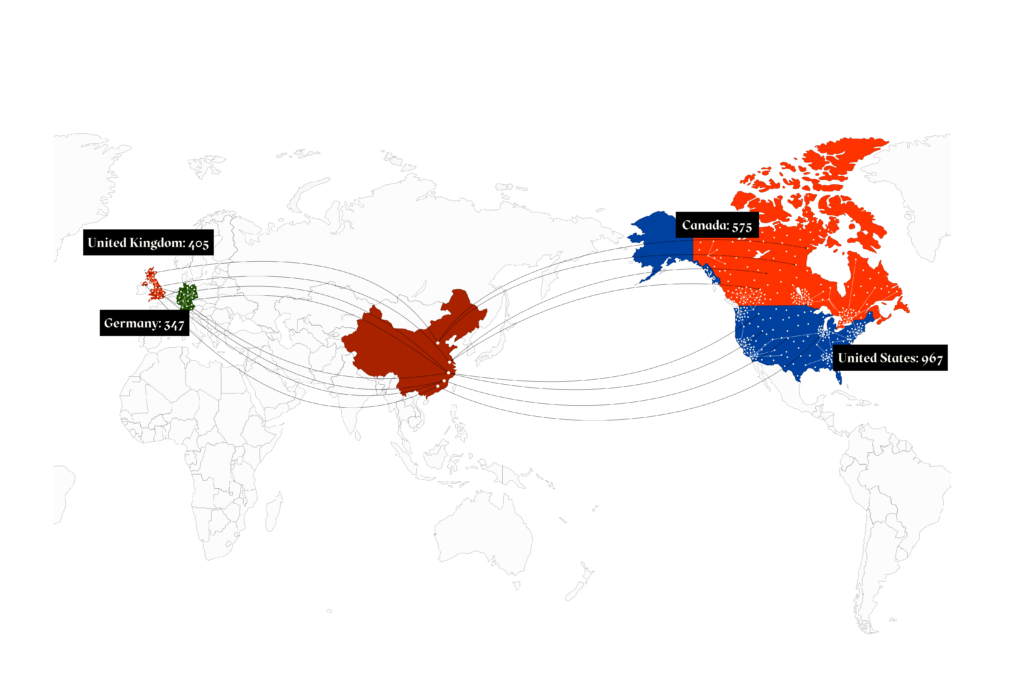
Cheryl Yu’s Harnessing the People: Mapping Overseas United Front Work in Democratic States presents a systematic examination of how the Chinese Communist Party operationalizes its united front system across four major democracies. By drawing on open-source research, the report identifies more than 2,000 organizations in the United States, Canada, the United Kingdom, and Germany that maintain direct or indirect connections to the CCP’s united front apparatus. These organizations constitute a distributed political infrastructure that can be mobilized in support of Party objectives, including national rejuvenation, global influence expansion, and unification with Taiwan.
The report traces the evolution of overseas united front work from Deng Xiaoping’s post–Cultural Revolution reopening to Xi Jinping’s consolidation of a globally oriented influence architecture. Party doctrine defines united front work as a strategic instrument for consolidating allies, neutralizing opposition, and shaping the external environment. Over time, target groups expanded from overseas Chinese elites and business figures to include students, professionals, religious leaders, private-sector actors, and broad categories of diaspora communities. Xi has reinforced the imperative of “uniting Chinese descendants at home and abroad,” integrating diaspora mobilization into China’s broader global governance ambitions.
Methodologically, Yu defines united front organizations as those with personnel overlap, institutional ties, event coordination, or documented engagement with entities such as the United Front Work Department, the Chinese People’s Political Consultative Conference, the Overseas Chinese Affairs Office, and affiliated bodies.
The resulting dataset categorizes 2,294 organizations across eight functional types:
- identity-based associations
- cultural and friendship organizations
- business and trade groups
- educational institutions
- student associations
- professional organizations
- political and policy-focused groups
- media outlets.
Identity-based groups form the largest category, followed by student and business networks.
The analysis identifies recurring operational patterns. United front organizations often promote a Party-aligned conception of Chinese identity rooted in national rejuvenation. Cultural and friendship associations function as soft power conduits, hosting events that project favorable narratives of the PRC. Business associations facilitate economic exchange and political access, often coordinating investment forums and official visits. Educational institutions and language schools reinforce diaspora identity formation and maintain structured relationships with PRC agencies. Student and professional groups create talent pipelines and networks that can be activated for technology transfer, policy advocacy, or crisis mobilization.
Case studies illustrate how this network operates in practice. Examples include coordinated protests during Taiwanese political transits, engagement with local governments, economic and technology linkages, transnational repression targeting dissidents, and collaboration with criminal elements. The report emphasizes that many activities occur under the cover of lawful civic engagement, while the Party’s role remains obscured.
The conclusion underscores transparency as the primary countermeasure. Much united front activity is publicly visible, yet foreign agent registration systems rarely capture these organizations. Yu argues that improved public awareness, interagency information sharing, and institutional scrutiny are necessary to reduce vulnerability to political conditioning and influence operations.
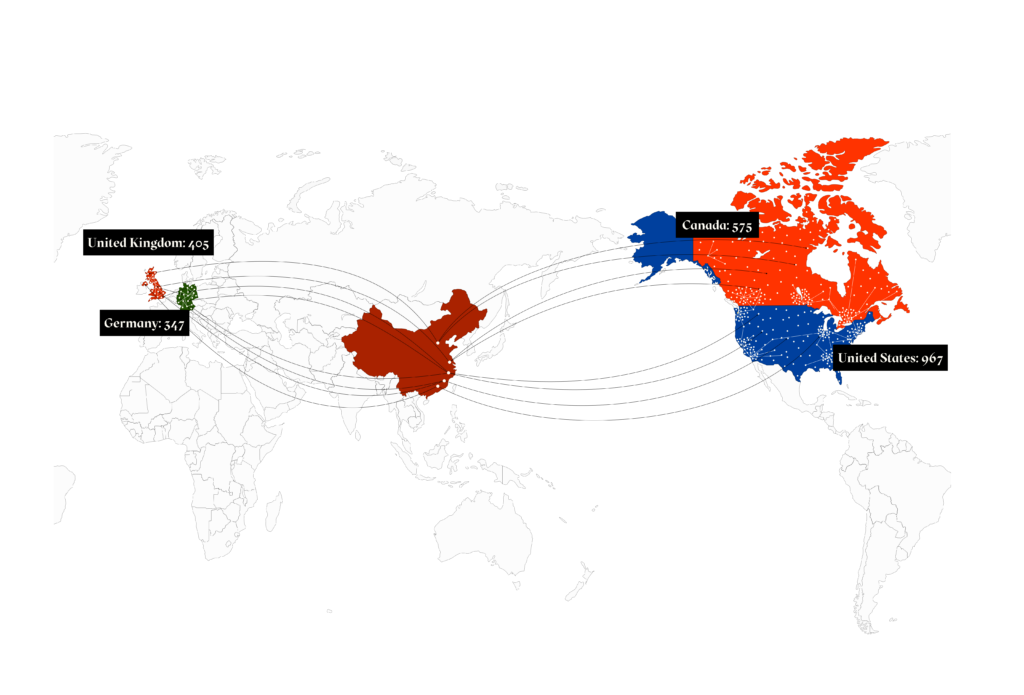
United Front-Linked Organizations Identified by Country
Harnessing the People: Mapping Overseas United Front Work in Democratic States
Executive Summary:
-
The Chinese Communist Party (CCP) has created a global network of individuals and organizations as part of its united front system. In four democratic states—the United States, Canada, the United Kingdom, and Germany—this network includes more than 2,000 organizations. These constitute latent capacity that the Party can mobilize to advance the Party’s agenda.
-
Beijing’s network is the product of protracted co-optation of existing civil society organizations overseas and the global expansion of domestic united front elements. The Party has spent decades assiduously cultivating overseas Chinese community organizations, co-opting local leaders and institutions to embed its preferences within civil society. Even groups that previously spent decades supporting the Republic of China (Taiwan) now fly the flag of the People’s Republic of China (PRC).
-
The Party leverages this global network to support its primary goal of national rejuvenation. According to the Party’s definition, rejuvenation entails unification with Taiwan and making the PRC the global leader in terms of national power. United front work supports this goal by contributing to the PRC’s diplomatic, economic, scientific, and even military development, as well as the Party’s ability to respond to crises, such as the COVID-19 pandemic.
-
This includes engaging in malign and illegal activities in foreign countries. Overseas groups with ties to the united front have directly supported illicit technology transfer, espionage, talent recruitment, and voter mobilization on Beijing’s behalf. These groups also engage in transnational repression, monitoring, harassing, and/or intimidating dissidents, ethnic minorities, and other critics of the Party.
-
In democratic countries, these groups influence political decision-making by conditioning stakeholders to consider Beijing’s interests and sensitivities. United front organizations have been instrumental in shaping the approaches of local governments and political actors, particularly where oversight is weak. They have influenced legislation and public statements, and managed official engagements with the PRC.
-
Where the CCP encounters opposition, the united front functions as a political weapon to isolate, neutralize, or counter Beijing’s critics. The united front system leverages its network of organizations to remove impediments to the achievement of core CCP ambitions through influence, subversion, co-optation, and coercion. These goals include building support for and neutralizing resistance to the annexation of Taiwan.
-
Constraining the CCP’s ability to interfere in democracies requires active transparency. Much of the CCP’s united front activity is at least partially visible in democratic societies. Better education and information sharing could help officials and the general public recognize risks and avoid entanglement. United front groups are rarely listed in existing foreign agent registration systems, limiting the ability of governments to monitor or investigate them.
The post Harnessing the People: Mapping Overseas United Front Work in Democratic States appeared first on Small Wars Journal by Arizona State University.

Related Articles


Venezuela receives more than 1,500 amnesty requests under new law
More than 370 political prisoners have already been granted amnesty under the...
Iran’s Students Hold Anti-Regime Protests as Universities Reopen
Students helped grow initial protests into a national movement crushed by the...
Kaillie Humphries Armbruster of U.S. wins record-tying sixth Olympic bobsled medal
Kaillie Humphries Armbruster won her sixth career Olympic medal, tying fellow American...
‘Absurd and provocative’: Huckabee faces firestorm for Israel border stance
Egypt, Jordan, Saudi Arabia denounce US ambassador’s remarks suggesting Israel has right...
Leave a comment