





Disappearances in Mexico surge by 200% over 10 years
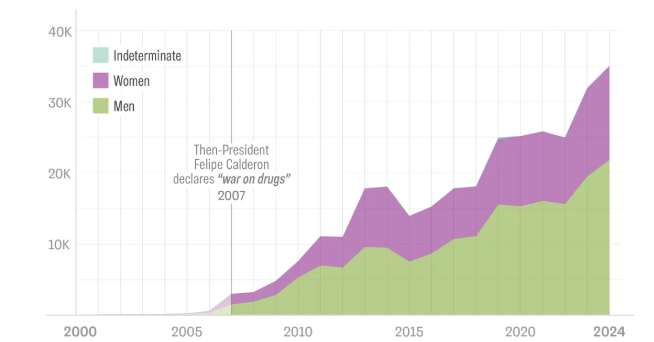
The Guardian’s recent article, Disappearances in Mexico surge by 200% over 10 years, reports that Mexico’s missing-person crisis now includes more than 130,000 people and links the surge in disappearances to expanding cartel power. The article opens with the 2022 abduction of Ángel Montenegro, whose case reflects how families often begin searching immediately and continue for years with limited state support.
The Guardian finds that “in the last 10 years, disappearances have increased more than 200%,” as criminal groups expand territorially and into new illicit markets. Cartels use disappearance strategically because “simply murdering other gang members is likely to catch the authorities’ attention: instead, cartels bury corpses in unmarked graves, burn them to ash or even dissolve them in vats of acid.” By doing so, “criminal groups ‘invisibilize the violence, because that puts them under the radar.’”
The Cartels also rely on abduction to support activities such as “organ trafficking, sex and human trafficking, and migrant smuggling.” Interviews from the report reveal that this violence spreads alongside weak governance, noting that “criminal power advances in parallel with institutional neglect.”
Mexico’s Missing Persons Crisis: Men, Women, and Indeterminate Cases from 2000 to 2024
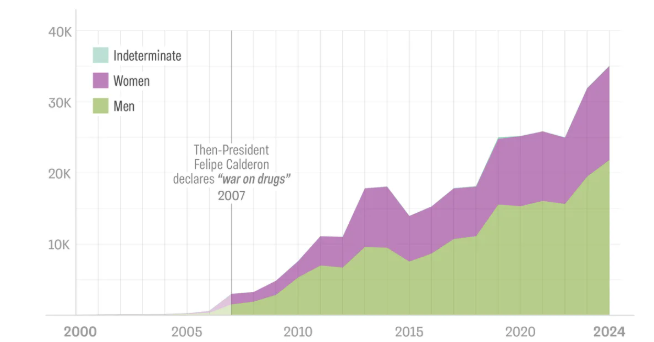
(Source: National Register of Missing and Disappeared Persons, RNPDNO)
Government efforts to track the disappeared have struggled with funding and political disputes, while investigations remain “often slow and ineffective, marred by corruption and incompetence.” To fill the gap left by limited state capacity, many families conduct their own searches, joining other bereaved families that go out “probing the ground with metal rods for signs of buried corpses.”
For a complementary perspective on The Guardian’s report, see SWJ El Centro’s recent article, Understanding Resistance and Mobilization in Mexico: Beyond the 2025 Gen Z Contestation of Cartel-Led Governance (Dec. 2025). Robert Burrell and Manuel Carranza analyze how cartel violence and disappearances increasingly affect younger populations, noting that “over 53,000 of the 130,000 disappearances in Mexico were Gen Z victims.” Their analysis reinforces the Guardian’s portrayal of disappearances not only as criminal acts but as mechanisms through which cartels assert authority over communities that lack governance and security.
The post Disappearances in Mexico surge by 200% over 10 years appeared first on Small Wars Journal by Arizona State University.

Related Articles


California mulls a billionaire tax, revealing a deeply divided state
Billionaires threaten to leave the state to avoid paying a tax that...
Trump has mulled timeline for Iran strikes, but no decision yet
Trump has not yet made a final decision about whether to strike...
FCC reject claims of censorship, announces probe into US show The View
Federal Communications Commission faces backlash after comedian Stephen Colbert blamed its rules...
Bodo/Glimt stun Inter Milan 3-1 in Champions League playoff first-leg
Norway’s Bodo/Glimt produce another Champions League shock by beating last year’s beaten...
Leave a comment