




Driving PME Transformation for the Total Force: CGSS’s Modernization of the ADL Common Core
Abstract:
The U.S. Army Command and General Staff College has comprehensively redesigned its Asynchronous Distance Learning Common Core (ADL-CC) program, reducing course length from 36 to 12 months and introducing a scaffolded, multimodal curriculum aligned with modern warfighting requirements. This transformation accelerates the production of MEL 4 qualified officers, enhances operational relevance, and ensures greater accessibility for Active Duty, National Guard, and Army Reserve officers, thereby strengthening the Army’s cognitive edge for large scale and multidomain operations.
Introduction
For almost a century and a half, the U.S. Army Command and General Staff College (CGSC) has shaped the intellectual foundations of the Army’s warfighting excellence. As America’s School for War, the institution has repeatedly adapted to changes in the character of conflict, from the mechanization and mass mobilization of the 20th century to the complex, multidomain operational environment of today. As a pioneer in distance education for over 100 years, CGSC has continually evolved its methods to reach officers wherever they serve, ensuring access to high-quality professional military education regardless of location or component.
Today, under the Army’s mandate for continuous transformation and the reorganization of the Training and Doctrine Command (TRADOC) to Transformation and Training Command (T2Com), CGSC is undertaking one of the most significant reforms to professional military education (PME) in its modern history: a comprehensive redesign of the Command and General Staff School’s Asynchronous Distance Learning Common Core (ADL-CC) program. This reform is not merely a pedagogical update. It is a deliberate structural transformation designed to enable more officers to rapidly complete the common core curriculum, producing more Military Education Level 4 (MEL 4, the Army’s intermediate level education qualification) qualified officers with relevant warfighting skills aligned with large scale combat operations (LSCO) and multi domain operations (MDO).
Asynchronous Distance Learning (ADL) is the Army’s primary mechanism for delivering Intermediate Level Education to officers who do not attend resident courses due to operational requirements, geographic dispersion, or component specific constraints. In a globally distributed Army with persistent operational demands, ADL is essential—it ensures the Army can develop adaptive, strategically minded leaders wherever they serve. The redesigned ADL-CC program represents a decisive step forward: an agile, relevant, and warfighting-focused learning model that reflects how the Army will fight and win in the decades ahead.
The Imperative for Change
This transformation is not merely administrative. It is strategic. The Army’s transformation effort demands a PME system capable of producing leaders who can integrate warfighting functions at echelon, understand operational art, and make decisions in contested multi domain environments. PME cannot lag behind operational modernization; it must drive it.
The ADL-CC redesign directly supports this mandate by:
- Increasing readiness for Joint All Domain Operations (JADO) and continuum competition by accelerating MEL 4 production through a focused curriculum, enhanced delivery, and increased faculty interaction, and
- Preparing officers for the cognitive demands of Large Scale Combat Operations (LSCO) and Multi Domain Operations (MDO), regardless of component, assignment, or operational tempo.
Like all PME institutions, CGSC must function within the strategic realities of Army readiness: limited resources, high operational tempo, and the constant need to balance force readiness with leader development. PME must adapt to evolving threats, comply with policy mandates, and support talent management, all while ensuring the Army remains prepared for the demands of modern warfare.
Prolonged Completion Times Limited Readiness
The legacy 36-month ADL-CC model promised flexibility but delivered delay. Without structured milestones or regular faculty engagement, officers across all components struggled to maintain momentum amid competing demands—operational tempo, deployments, civilian careers, and family obligations.
The result was predictable. Students remained inactive for months, then rushed to complete assessments in the final weeks. Many never finished at all. Completion rates declined as the timeline stretched, creating a systemic bottleneck that reduced MEL 4 throughput precisely when the Army needed to expand its leadership bench.
Officers awaited qualifications. Developmental assignments went unfilled. Units operated without fully qualified staff officers. What began as a flexibility feature had become a readiness constraint.
Inefficient Policies Constrained Availability and Wasted Resources
Flexible enrollment policies compounded the timeline problem by allowing uncommitted students to occupy limited seats. The data was stark: 10% of enrolled students never started, 18% withdrew after the first course block, and many re-enrolled repeatedly without completing. Each abandoned seat meant a motivated officer waiting months for an opening; a revolving door that consumed resources without producing qualified leaders.
The curriculum structure amplified the problem. Frequent doctrinal updates, necessary to maintain relevance, forced students to restart entirely when content changed. The course lacked a scaffolded design where lessons build cumulatively on previous learning. Instead, concepts felt disconnected, preventing students from leveraging earlier mastery to tackle later complexity. This violated fundamental adult learning principles and made an already lengthy course feel even more overwhelming.
National Guard and Reserve officers bore the heaviest burden. Citizen-Soldiers couldn’t afford to wait indefinitely for enrollment, invest months in coursework, then restart due to doctrinal changes. Career timelines stalled. Promotion opportunities passed. The Total Force deserved better.
Army Regulation 350-1 Raised the Stakes
The 2025 update to AR 350-1, Army Training and Leader Development, established a new requirement. Officers now have five years from attaining promotable status to complete ILE. Under the 36 month ADL-CC model, many officers were simply running out of time. PME delays became promotion delays, assignment delays, and readiness delays. The conclusion was unavoidable: the legacy ADL-CC model no longer met the Army’s needs. The solution was a complete redesign of the structure and delivery.
What Changed? The 12 Month, Three Phase ADL-CC
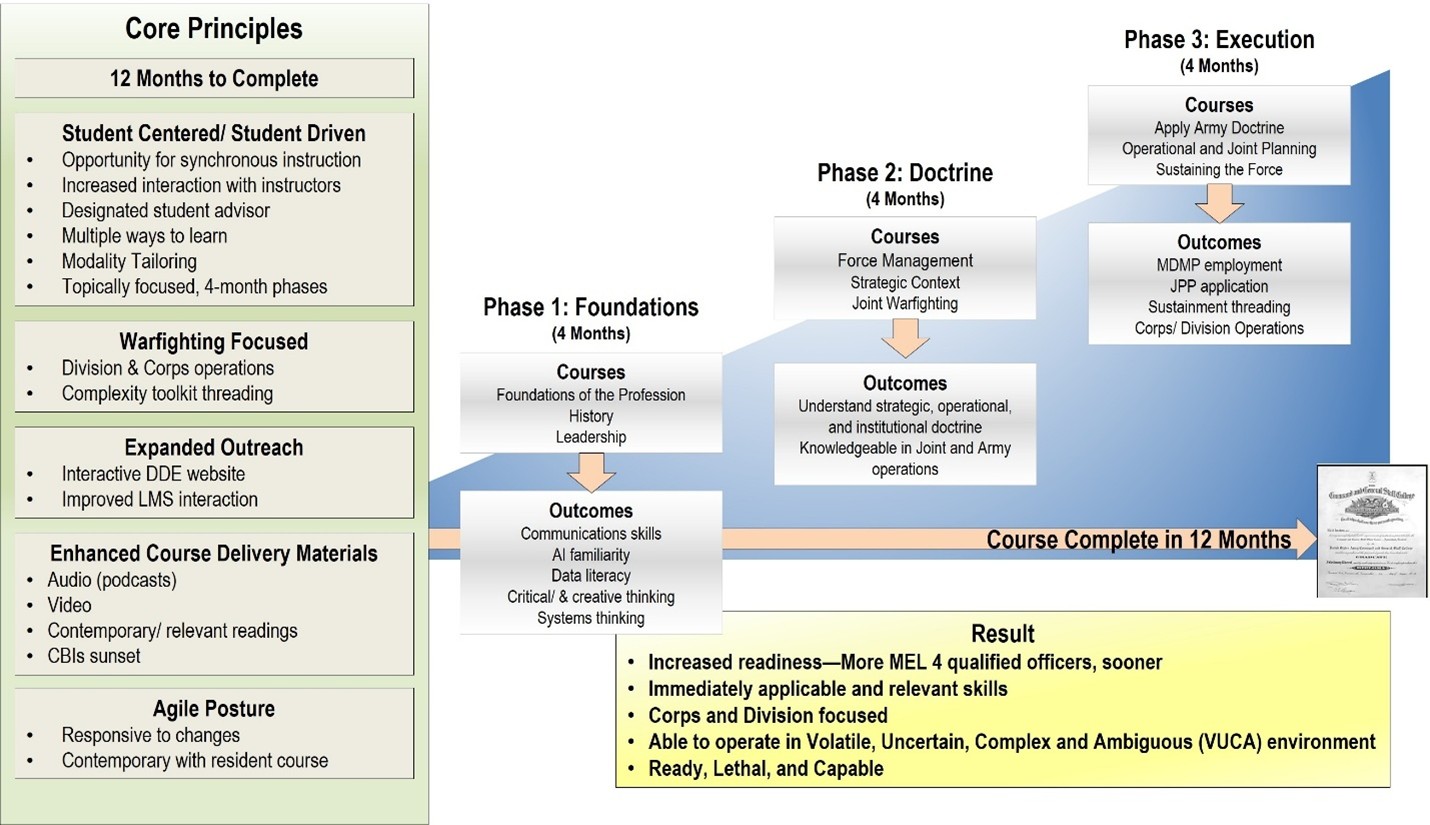
CGSS’s redesigned ADL-CC (Figure 1) represents a comprehensive modern redesign aligned with Army Learning Concept 2030–2040, the Army’s transformation initiative, and the Community of Inquiry (CoI) model commonly used in civilian education instructional design. It introduces a 12 month, three phase scaffolded program delivered through multimodal learning, supported by embedded human mentorship, and engineered to be relevant to LSCO, MDO, and Joint Operations. The redesigned structure replaces the unfocused, multiyear progression with a precise, disciplined, and outcome driven sequence:
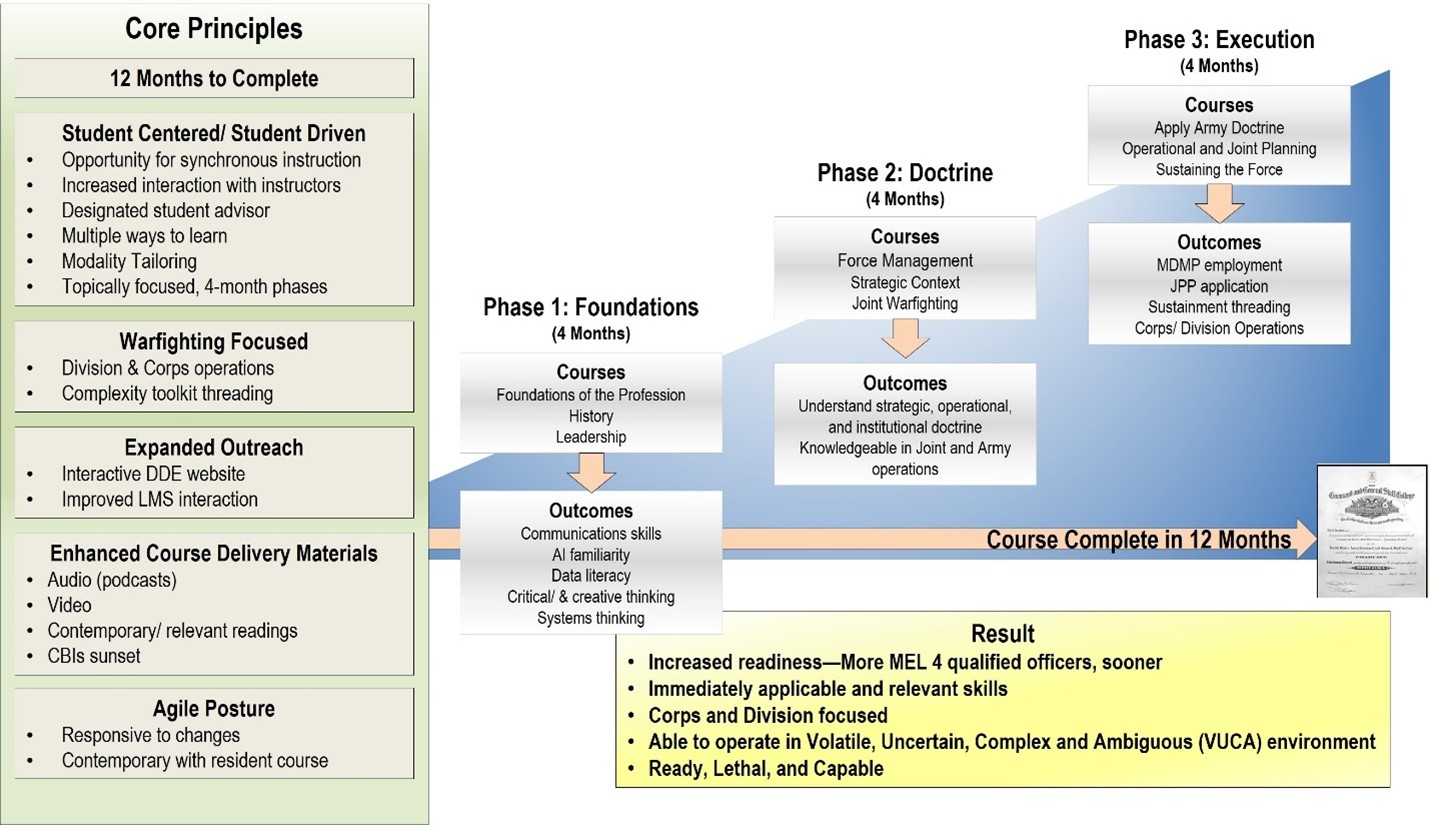
Figure 1: CGSS ADL-CC Three Phase Structure. Source: CGSC Department of Distance Education
Phase 1: Foundations (4 months)
Phase 1 (Foundations of the Profession, Leadership, and Military History) now serves as a permanent anchor. Because doctrine rapidly evolves, all doctrine dependent instruction was moved out of Phase 1 to ensure students never lose credit due to doctrinal updates, while still allowing time to complete the course. This phase introduces the Complexity Toolkit and establishes grounding in communication, critical thinking, professional identity, the human dimension of leadership, and the historical context of operations. Lessons are sequenced intentionally so that communication skills, problem framing, and systems thinking are introduced early and become the intellectual scaffolding for later doctrine and planning work.
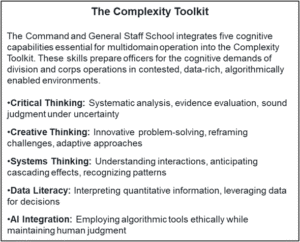
Figure 2: The Complexity Toolkit. Source: Author produced. Note, intended as a callout.
Phase 2: Doctrine (4 months)
Phase 2 consists of three blocks of instruction: Strategic Context, Joint Warfighting, and Force Management. These subjects are reinforced by multidomain perspectives and the Complexity Toolkit. This phase builds directly on Phase 1 by introducing the doctrinal foundations of how the Army operates, integrates with the Joint Force, and generates the capabilities required for multidomain outcomes. Lessons follow a structured progression. Students analyze the strategic environment, then apply joint doctrine, then understand how the Army builds and fields formations to execute those concepts. This logical scaffolding reinforces cumulative learning and mirrors how commanders and staffs think through problems in the real world.
Phase 3: Execution (4 months)
Students will then complete a capstone phase that emphasizes Army doctrine, joint planning, and sustainment, culminating in the application of operational art in LSCO environments. Phase 3 requires students to synthesize everything learned in Phases 1 and 2. Planning, decision making, sustainment integration, and operational art are applied to complex LSCO/MDO scenarios. Sustainment emphasizes how logistics enables execution at echelon and ensures endurance, reach, and freedom of action.
This structure reduces the legacy course length by as much as two years while preserving all CGSS Learning Objectives and Outcomes. It reduces instructional hours by 30%, eliminates redundancy, and shifts learning from seat time to outcome driven mastery aligned with division, corps, and Joint Task Force (JTF) level operations. The result: officers can complete PME efficiently and purposefully, but without sacrificing rigor.
Making it Work
The modernization of the ADL-CC is more than a content overhaul—it is a comprehensive effort to create a PME experience that truly works for today’s Army officers. Recognizing the unique challenges faced by adult learners balancing operational, professional, and personal responsibilities, the program is designed to improve accessibility, flexibility, and relevance at every step.
Student Focused:
At the heart of this modernization is a commitment to a positive student experience. The redesigned ADL-CC program delivers targeted support and innovative learning tools to ensure every officer can succeed, regardless of their schedule or location. Key features include:
- Cohort Advisors and Active Support. Every student is assigned a cohort advisor who provides mentorship, structured support, and ready advice. Advisors coordinate with a dedicated Help Desk to intervene early when students have challenges, addressing the historically high attrition seen in the first phase.
- Synchronous Touchpoints in an Asynchronous Environment. Study halls, office hours, and targeted instructional sessions give students structured opportunities for interaction while preserving the flexibility of asynchronous coursework. National Guard, Army Reserve, and deployed students gain access to faculty support without requiring fixed attendance.
- Multimodal Learning for Modern Warfighters. The redesigned course replaces static computer based instruction with a contemporary suite of instructional tools that allow students to pick what they need to learn, including:
- Professionally produced videos from Army University Press Films to provide a deeper understanding of the subjects.
- Video based, instructor produced lesson overviews and whiteboard sessions to focus the students on learning objectives.
- 10–15 minute course specific audio podcasts focused on helping students understand and provide context of the lesson.
- Short podcasts and recorded microlessons to clarify the most complex ideas and concepts.
- Narrated slide presentations
- Transcripts, templates, examples, and study guides
- Links to other supporting media
This ecosystem supports all learning preferences and schedules, improves understanding, and reduces the time burden on working officers.
A Warfighter Curriculum Anchored in LSCO, MDO, and Complexity
The redesigned ADL-CC is not merely shorter; it is more operationally relevant. This fast paced and agile curriculum is characterized by:
- Division and Corps Operations at the Center. The new curriculum directly prepares officers for division and corps staff assignments, the heart of LSCO and MDO. Core learning emphasizes integrating warfighting functions, decision making in Volatile, Uncertain, Complex, and Ambiguous (VUCA) operational environments, and applying operational art across domains.
- The Complexity Toolkit. Integrated across all phases, the Complexity Toolkit (Figure 2) develops the cognitive capabilities essential for algorithmic, data-rich, and cyber-influenced battlefields, mirroring the resident CGSS instruction.
- Agility and Doctrinal Currency. The modular, multi modal design enables rapid updates that keep pace with doctrinal changes, emerging force structure, and lessons learned from multidomain experimentation.
A New Hosting Platform
A central component of the ADL-CC modernization effort is CGSS’s new partnership with Arizona State University (ASU) to host, enhance, and expand multimodal content delivery. ASU brings world class instructional design and a modern digital learning platform, allowing CGSS to enhance student centric delivery across all phases. This collaboration enables CGSC to harness the same advanced educational tools used by top tier civilian institutions while retaining complete control over military content and doctrinal rigor. It ensures the ADL-CC program remains flexible, resilient, scalable, and future ready.
The Result: A More Ready and Capable Officer Corps
The ADL-CC redesign is expected to deliver immediate and measurable benefits:
- Higher Completion Rates. The 12 month structure, combined with scaffolding, multimodal delivery, and embedded support, is projected to increase completion across all components significantly.
- Improved Throughput and Readiness. The Army can produce more MEL 4 qualified officers each year, reducing PME bottlenecks and expanding the pool of officers ready for developmental assignments.
- Operationally Relevant Skills on Arrival. Graduates will arrive at division and corps staffs capable of contributing immediately to planning, integration, and decision making in LSCO/MDO environments.
- Accessibility and Equity Across Components. The modernized model ensures that Active Duty, National Guard, and Army Reserve Soldiers can complete PME faster, with less career disruption, resulting in:
- Improved Readiness and Talent Management. Faster PME completion means more officers available for key developmental positions and assignments requiring MEL 4 qualification.
- Operationally Relevant Leaders on Arrival. Graduates possess the data literacy, systems thinking, and decision making skills necessary for division and corps operations in LSCO/MDO environments.
- Greater Accessibility. Modernized delivery ensures that Active Duty, National Guard, and Army Reserve officers with diverse schedules and operational demands can succeed without sacrificing rigor.
Unified Modernization for the Army’s Cognitive Edge
For over a century, the U.S. Army Command and General Staff College (CGSC) has pioneered distance education, ensuring that Army leaders across the globe receive high quality professional military education. Today, the comprehensive redesign of the ADL-CC program builds on this legacy, aligning with the larger modernization of CGSC under Army University and T2Com.
As CGSC modernizes resident programs with AI integration, collaborative digital platforms, and data-driven instruction, the ADL-CC redesign ensures distance learners receive the same warfighter-focused, technologically integrated PME experience. This unified approach to modernization—across resident and distance modalities—ensures every officer, regardless of component or location, develops the cognitive capabilities required for multidomain operations.
The redesigned ADL-CC represents more than curriculum reform; it is a strategic investment in the Army’s cognitive advantage. By enabling officers to complete MEL-4 education efficiently while maintaining operational relevance and doctrinal currency, CGSC ensures the Army can generate the adaptive, strategically minded leaders essential for success in large-scale combat operations.
In an era defined by velocity, complexity, and multidomain competition, the Army’s advantage will increasingly depend on cognitive overmatch. The modernized ADL-CC ensures CGSC continues its historic mission: preparing leaders to think critically, act decisively, and integrate warfighting functions in the most demanding operational environments—wherever they serve.
The post Driving PME Transformation for the Total Force: CGSS’s Modernization of the ADL Common Core appeared first on Small Wars Journal by Arizona State University.
Related Articles

Scores left stranded by floods in southwest France
Some 80 people have been left stranded in Marmande, a small town...


Iran’s Protests Have Ended, but the Anger and Pain Haven’t
In the aftermath of another wave of antigovernment unrest, Iran is gripped...
A Russian ‘Village of Military Valor’ Waits for Its Reward
A provincial governor seeks to honor villages that deployed many soldiers to...
Prices Jump as Venezuelans Abroad Consider Buying Property Back Home
Nicolás Maduro’s capture and talk of oil investment have pushed prices higher,...
Leave a comment