



Disciplined Autonomy: How AI and sUAS Will Redefine Security, Safety, Emergency Response, and Military Operations

Mature AI systems are not free-thinking actors; they are bounded executors of human intent. Let’s face it, AI is only beginning to take shape, and there is a need for a different lens on the maturing technology. This is especially concerning for drones, also known as Small Unmanned Aircraft Systems (sUAS), used by operators and professionals in the Department of War and the private sector, including those involved in security, safety, and emergency preparedness. The following ideas and concepts are based on how decision-making takes shape in an AI and autonomous world. The framing of human-in-the-loop, human-on-the-loop, and human-out-of-the-loop will take on a whole new perspective based on these ideas, a framework that supports proactive action in a governed ecosystem. In the debate over artificial intelligence (AI) and autonomous systems, one statement is far more accurate than the rhetoric suggests: we remain at the very beginning of AI maturity. The capabilities of machine learning and data fusion are impressive; the capabilities of autonomous decision-making remain nascent in serious operational contexts. Nowhere is this truth clearer than in the evolution of sUAS. The growing presence of sUAS across civilian, public safety, and military domains demands not only technical advancements but also a disciplined progression of trust, governance, and accountability. Without a mature framework for how AI earns operational authority, organizations risk catastrophe at scale. The concepts outlined in this framework fall under each of the following categories—”Understand, Investigate, Decide, Normalize, Continuously Refine, and Mature”—and act as a lens for professionals in security, safety, emergency management, and military operations to view maturing AI, autonomy, and the future differently than traditionally posited. It illustrates why AI in sUAS must be governed as a command-and-control problem, why autonomy should be earned deliberately, and why technology cannot substitute for responsible authority. Understanding how to transform raw capabilities into responsible autonomy requires operational experience. This framework helps to shape thought and approach and emphasizes that drones present evolving threats to public safety, critical infrastructure, transportation, sensitive sites, military installations, and mass gathering venues that professionals must understand and anticipate rather than fear.
The real measure of AI maturity is not performance benchmarks or hardware specifications, but whether organizations know what AI is doing, how it is doing it, and how authority and accountability flow when systems act autonomously under pressure.
The Need for a Disciplined Maturity Framework
Small unmanned aerial systems have transitioned from niche tools to strategic infrastructure within a remarkably short time. Their proliferation was built not in laboratories, but in global markets: consumer drones purchased off the shelf, adapted for industrial inspection, agriculture, media production, and then, in conflict zones. They were adapted once again for military, reconnaissance, and even direct strike roles. Evidence from recent operations underscores this shift. It is documented how commercial and military drones have fundamentally reshaped the modern conflict environment, enabling missions ranging from intelligence, surveillance, and reconnaissance (ISR) to coordinated indirect fire support and multi-domain integration.
What this example illustrates is that drone capability often arises rapidly, evolving in its use cases before doctrine, governance, or training can be written around it. It should also be noted that organizations too often rush to adopt technological solutions without fully understanding their strategic effects or operational failure modes.
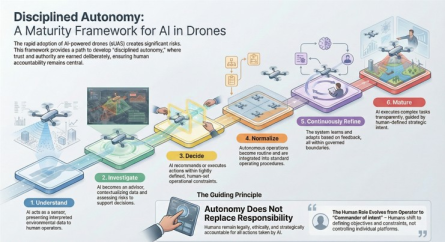
This pattern of technology outpacing governance carries significant risk. In security contexts, unsupervised autonomy can compromise civil liberties or public safety. In emergency response, it can misallocate critical resources at moments when human judgment is paramount. In military operations, premature delegation of decisions to AI systems without clear intent or accountability can lead to escalation or unintended consequences. Addressing these challenges requires a framework for maturity that treats AI capability not as an end in itself but as a progression of earned trust.
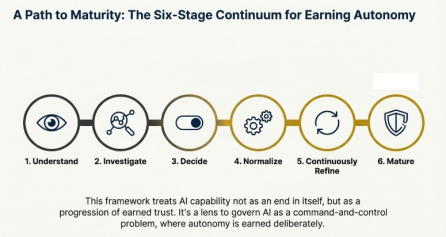
Figure 1: “Understand, Investigate, Decide, Normalize, Continuously Refine, and Mature” continuum.
Understanding “Understand”
The first stage of maturity is “Understand”, where AI’s role is purely perceptual. At this phase, AI systems ingest data, analyze sensor inputs, and present an interpreted representation of the environment to human operators. In sUAS, this includes visual recognition, airspace awareness, and sensor fusion across modalities such as imagery, radar, and radio frequency signatures.
Detection does not equal comprehension. Seeing a pattern does not mean understanding its operational significance. Many organizations assume that because AI can label an object or identify an anomaly, it therefore “understands” its implications. In professional circles, this error is sometimes referred to as the automation illusion—the faulty assumption that machine classification equals meaningful judgment.
When training security and emergency professionals, there needs to be an emphasis that awareness must be anchored in context before it can inform decisions. Training courses teach participants to integrate AI perception with risk scoring, legal constraints, and operational posture before allowing automated actions. For example, in emergency management, a drone’s ability to identify a heat signature is valuable, but without contextual analysis—what the heat source represents, how it affects human responders, and whether other hazards are present—means the information is incomplete.
Investigate: Adding Context and Caution
Once a system can detect, it must contextualize. “Investigation” is the phase where AI begins to correlate patterns, contrast scenarios, and provide risk assessments to operators. Here, AI bridges the gap between raw data and operational meaning, but still within a decision support role. The system may indicate that a detected anomaly matches a known threat pattern, or that environmental conditions suggest elevated risk, but the authority to act remains human. This phase is where systems move from being tools to being advisors. Mismanaged, this transition creates expectations that the system “knows best.” Professionals in this space should start to sense and begin to see that the alarm bells are being repeatedly sounded, and that organizations too often prematurely outsource interpretation to algorithms without sufficient vetting of assumptions or error modes. In homeland security applications and critical infrastructure protection, there needs to be an emphasis on investigating not just raw sensor data, but broader patterns of behavior—what modes of employment make sense, how adversaries might adapt, and what legal and ethical constraints govern autonomous interpretation.
Investigation is where trust is built incrementally. AI can flag patterns humans might miss, but this phase must be accompanied by rigorous validation, red teaming, and procedural checks. Without these safeguards, false positives or misinterpreted cues can lead to wasted resources, misdirected emergency response, or erroneous security escalations.
Decide: Guardrails Before Authority
The third phase, “Decide”, is the first inflection point in autonomy. In this stage, AI begins to recommend or execute actions within tightly defined operational constraints, whether that is route adjustments for drone flights, prioritization of threats, or tactical recommendations for first responders. Regardless of implementation style, the key characteristic is actionable authority. Many organizations are tempted to accelerate this phase, believing that operational speed justifies earlier delegation. This is precisely where most incidents of automation failure occur. Automation bias—the tendency to defer to machine recommendations—becomes most dangerous here, because humans may cease to question AI outputs, even when conditions exceed design assumptions. It boundaries. It is essential to stress that systems may provide tactical recommendations, but humans must retain escalation authority and understand the limitations of machine decision-making. This principle applies across security, emergency, and military operations, ensuring that decision authority is transparent, auditable, and bounded by human intent.
Normalize: Routine Autonomy Comes of Age
When autonomous decision-making becomes routine, the system enters “Normalize”. Here, AI operates within standard operating procedures (SOPs) and established protocols. Examples include autonomous patrols, Beyond Visual Line of Sight (BVLOS) missions, and prescribed reconnaissance flows.
Normalization brings efficiency, but also risk. Once autonomous behavior is routine, organizations often assume competence by default. Technologies that “usually work” can mask failure modes that are rare but consequential. Standardization without governance is complacency, highlighting the need for integrated risk management frameworks. Normalized AI transforms organizational workflows. Security teams plan around autonomous patrol cycles, emergency managers build incident flows expecting drones to arrive first, and military commanders incorporate autonomous reconnaissance into timelines. While this represents progress, it also embeds AI into decision loops where human oversight may be minimized if not deliberately structured.
Continuously Refine: Learning With Boundaries
Once autonomy is routine, the next stage is “Continuous Refinement”. Conditions evolve, adversaries adapt, environmental dynamics shift, and missions change. Continuous refinement incorporates feedback loops, retraining, policy updates, and procedural adjustments. Governance is critical. Learning systems, if unconstrained, can drift into behaviors misaligned with organizational intent. Advocating for governed learning loops, integrating red teaming, ethical reviews, and cross-domain analysis to maintain alignment with human objectives is the next logical step.
In emergency response, refinement optimizes mission effectiveness, such as determining the most effective flight routes or sensor combinations to yield the most actionable information. In security and military domains, refinement can accelerate detection and decision cycles—but only when constrained by clear rules of accountability.
Mature: Disciplined Autonomy Under Human Intent
The final stage, “Mature”, is not independence, but disciplined execution within well-defined human intent. Mature systems operate predictably, audibly, and transparently under human-defined constraints. In mature deployments, humans define strategic objectives, constraints, escalation authorities, and ethical limits. AI executes repetitive, time-critical, or dangerous tasks within these boundaries. Decision authority is delegated in a controlled fashion, with mechanisms for accountability and oversight.
Highlighting that mature counter-UAS systems must integrate into broader risk management frameworks encompassing people, processes, policy, and technology is an important step in the maturity of security programs, which are often focused on physical and cyber aspects. This leaves out the critical new wave of sUAS capability that has completely upended how we should think about comprehensive program approaches. Lessons from Ukraine demonstrate that immature adoption can lead to unpredictable outcomes, whereas mature deployments rely on structured integration with command cycles and explicit intent.
Implications Across Domains
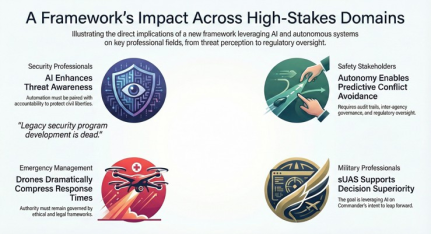
This maturity framework has distinct implications for multiple professional domains:
- Security Professionals: AI perception and investigation can enhance threat awareness, but normalization must be coupled with accountability to protect civil liberties while accounting for the fact that legacy security program development is dead.
- Safety Stakeholders: Autonomy enables predictive conflict avoidance but requires audit trails, inter-agency governance, and regulatory oversight.
- Emergency Management: Drones can compress response timelines, but the authority to prioritize resources must remain governed by ethical and legal frameworks.
- Military Professionals: sUAS support decision superiority, yet early delegation of authority can risk escalation or misapplication of force or misdirected outcomes. Essentially, leveraging AI to understand and act on a Commander’s intent would be a monumental leap forward.
Across all domains, the principle is clear: autonomy does not replace responsibility. Humans remain accountable legally, ethically, and strategically while operationalizing AI and autonomy in a manner that supports success in security and military operations.
The Future
AI Maturity by 2035 (Using Your Model):
| Phase | 2035 Reality |
| Understand | Fully automated, continuous sensing |
| Investigate | AI performs contextual threat & risk analysis. |
| Decide | AI executes most tactical decisions. |
| Normalize | Autonomous drone operations are routine. |
| Continuously Refine | Systems adapt faster than humans can |
| Mature | Humans define intent; AI executes |
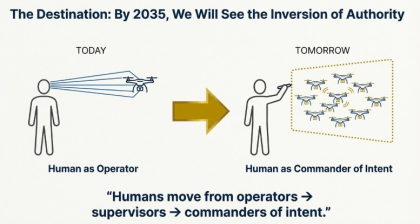
Humans move from operators → supervisors → commanders of intent.
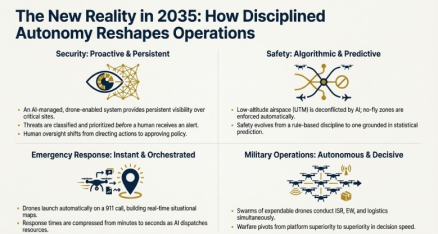
By 2035, security across public spaces, critical infrastructure, borders, and high-value sites will operate as an AI-managed, drone-enabled, persistent system in which humans intervene only when something falls outside the norm. Continuous low-altitude patrol drones will provide uninterrupted visibility, feeding data into AI engines that correlate signals from RF sensors, cameras, cyber systems, and ground detectors. Threats will be classified and prioritized before a human ever receives an alert. Security will shift from a reactive posture to a preventative one, with always-on sensing, pattern‑of‑life analysis, autonomous dispatch, and self-updating threat models becoming routine. Human oversight will focus on approving policy rather than directing individual actions.
In the realm of safety—whether in aviation, public spaces, or dense urban environments—oversight will become algorithmic first and human second. Low‑altitude airspace will be deconflicted by AI, no-fly zones will be enforced automatically, and accidents will be predicted and avoided before people even perceive the risk. Cities will come to expect autonomous airspace management, nascently referred to as unmanned traffic management (UTM), as a baseline function, much like network traffic routing today. Safety will evolve from a rule-based discipline to one grounded in statistical prediction and continuous adaptation.
Emergency response will undergo an equally profound transformation. The first minutes of any fire, EMS, disaster, or search‑and‑rescue event will be orchestrated by AI and led by drones. Upon a 911 call, drones will launch automatically, building real-time situational maps that identify heat signatures, structural damage, and potential victims. Resources will be dispatched before human responders arrive, compressing response times from minutes to seconds. Over time, each incident will refine the system, enabling AI to coordinate multi-agency responses with increasing precision.
Military operations will experience a decisive shift as small drones become expendable, autonomous, and central to tactical and strategic outcomes. Swarms will conduct ISR, electronic warfare, deception, and logistics simultaneously, while human control moves toward defining mission intent rather than manipulating individual platforms. AI will interpret enemy behavior and adapt tactics in real time, making drone loss an expected and inconsequential part of operations. Warfare will pivot from platform superiority to superiority in decision speed, with commanders managing objectives rather than machines. In general, AI should be a realistic tool. Platforms that are simple to use, can be repaired quickly, and decrease the pressure on the operator to fix complex issues are needed. Operators of these systems need to remain in control while being capable of conducting mission after mission without much intervention. It is here where the human remains in the loop as technology matures and takes us to the next phase of true human-out-of-loop capability with a decreased load on the operator. Simply stated, repeatability is a major goal.
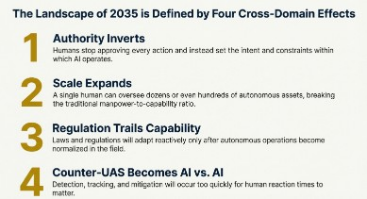
Across all sectors, several cross-domain effects will define the new landscape. Authority will invert as humans stop approving every action and instead set the intent and constraints within which AI operates. Scale will expand without proportional manpower, enabling a single human to oversee dozens or even hundreds of drones. Regulation will trail capability, with laws adapting only after autonomous operations become normalized. Counter‑UAS will evolve into an AI‑versus‑AI contest in which detection, tracking, and mitigation occur too quickly for human reaction times to matter.
These advances carry strategic risks if implemented poorly. Over-trust in immature AI, weak policy definitions, opaque decision processes, and public backlash after high-visibility incidents could undermine progress. True maturity will depend not on the speed of adoption, but on governance—clear rules, transparent systems, and disciplined oversight, that is, human-on-the-loop.
A decade from now, drones will not feel revolutionary; they will feel inevitable. The defining change will not be the aircraft themselves or the sensors they carry, but the shift in who makes decisions and how quickly those decisions occur.
Conclusion
This evolution can be captured by simply stating: maturity is earned, not declared. In ten years, drones will not feel revolutionary. They will feel embedded. They will be part of the background infrastructure of security, safety, emergency response, and military operations. The real transformation will not be what drones can see or how far they can fly, but who is trusted to decide—and at what speed. This is why it is critical to recognize a simple truth: we are still at the very beginning of AI. Similarly, we are early in the evolution of AI and autonomous systems for sUAS. These capabilities will continue to expand, but authority, trust, and accountability will determine whether these systems augment our decision cycles or undermine them. This framework of “Understand, Investigate, Decide, Normalize, Continuously Refine, and Mature” charts a path grounded in operational realism. It emphasizes deliberate progression, governance, and institutional trust by combining operational expertise with governance-oriented guidance. The framework demonstrates that the future of AI and sUAS is defined not by the sophistication of sensors or algorithms, but by how responsible organizations govern the authority they grant these systems to have.
Looking ahead, the greatest policy failure would be assuming that autonomy equals independence. Mature AI systems are not free-thinking actors; they are bounded executors of human intent. It must be stressed that in counter-UAS and security domains, humans must remain accountable—not because machines are incapable, but because responsibility cannot be automated. It’s the old saying: “You can delegate authority, but not responsibility.”
If we get this right, the payoff is enormous: safer skies, faster emergency response, more resilient security, and military operations defined by decision advantage rather than mass. If we get it wrong, we risk fragile systems operating at speeds humans can no longer meaningfully control.
The future of sUAS and AI will not be defined by technology alone. It will be defined by how patiently we mature it, how rigorously we govern it, and how honestly we acknowledge where we are today.
We are not late.
We are early.
The post Disciplined Autonomy: How AI and sUAS Will Redefine Security, Safety, Emergency Response, and Military Operations appeared first on Small Wars Journal by Arizona State University.

Related Articles
Young Voters in Bangladesh Have Demands for Thursday’s Election
Young voters, many of whom participated in a student-led revolution that toppled...
Kenya’s Mau Mau History
Chao Tayiana Maina explains how colonial methods of repression used against the...


Epstein fallout confined to Europe, prominent figures in US largely immune
Angela Diffley is pleased to welcome former New York State Assistant Attorney...
Leave a comment