





From Lenin to the Narcos: Manwaring’s Lessons on Political War in the Age of Paramilitaries


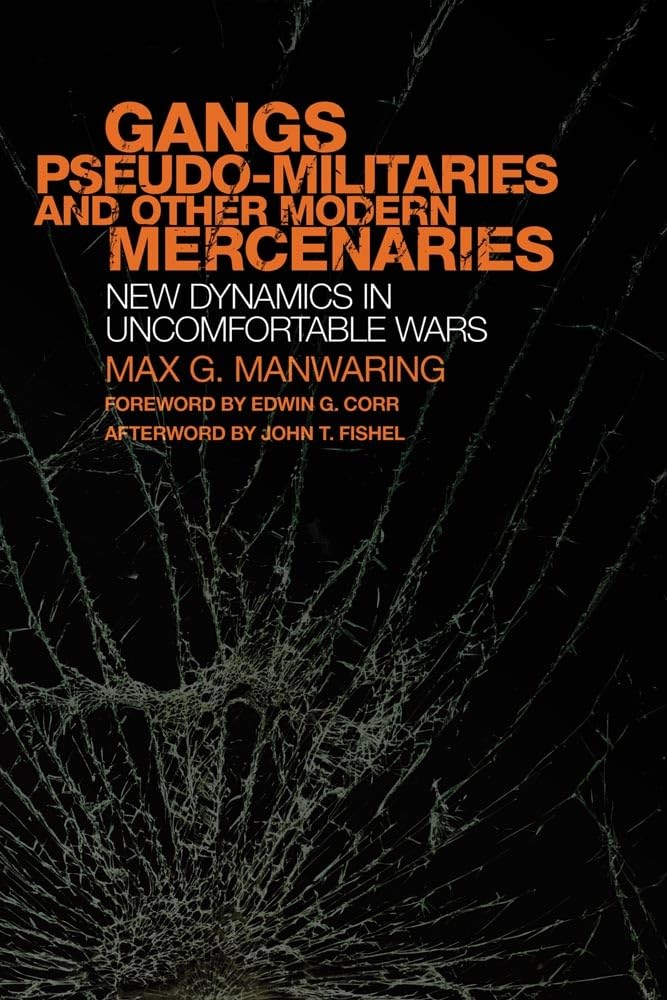
Gangs, Pseudo-Militaries, and Other Modern Mercenaries. By Max G. Manwaring. Norman: University of Oklahoma Press. 2010. ISBN: 978-0806141466. Maps. Photographs. Glossary. Notes. Sources Cited. Index. Pp. i, 258. $26.95.
In Gangs, Pseudo-Militaries, and Other Modern Mercenaries, Max G. Manwaring argued that contemporary conflict had become a form of “indirect but total war,” where state and nonstate actors deploy gangs, militias, and criminal networks to coerce political change. Writing in 2010, Manwaring rooted this logic in Lenin’s revolutionary model of phased struggle, but his insight reaches beyond leftist movements. Today, the Leninist template of indirect political war—blending propaganda, coercion, and proxy violence—has been adopted by actors across ideological lines, from Russia’s Wagner Group to Mexico’s cartels to Sudan’s Rapid Support Forces. The fusion of criminal and political motives that Manwaring foresaw now defines the landscape of modern irregular warfare.
Manwaring has long been recognized as one of the leading theorists of counterinsurgency and irregular warfare, best known for developing the SWORD model—a framework emphasizing legitimacy, unity of effort, and the integration of hard and soft power in small wars. In Gangs, Pseudo-Militaries, and Other Modern Mercenaries (2010), Manwaring extended his earlier work by arguing that contemporary conflict had evolved into what he termed “irregular asymmetric political war.” This was not a struggle confined to insurgent movements or failed states; it was a total, multidimensional competition in which nonstate intermediaries—gangs, militias, cartels, and mercenary networks—served as instruments of political power. These actors, he wrote, “appear to be formless and do not often present a coherent structure that can be attacked militarily” (pp. 4), yet they operate as deliberate extensions of statecraft.
At the center of Manwaring’s analysis is a strategic shift: the decisive terrain of modern conflict has moved from the battlefield to the political and psychological sphere. The aim of war, he insists, remains Clausewitzian—compelling an adversary to do one’s will—but the center of gravity has changed. Success or failure now depends on morale, perception, and legitimacy rather than on military capability. “Information (propaganda)—not military technology or firepower—is the primary currency by which modern ‘war amongst the people’ is run” (pp. 15).
To explain how this kind of political warfare is organized and sustained, Manwaring turns to the revolutionary method articulated by Vladimir Lenin—a model that transforms information, agitation, and organizational discipline into instruments of strategic coercion. In many ways, Lenin’s early twentieth-century conception of propaganda as a weapon of statecraft anticipates today’s information operations and influence campaigns, where the battle for perception replaces the battle for territory.
The result is a theory of conflict as political engineering. Gangs, cartels, and pseudo-militaries are not peripheral criminals, but strategic tools used to restructure the political order. They advance their patrons’ interests by manipulating public perception, coercing populations, and degrading institutional legitimacy. Manwaring’s Jamaican posses, Argentine Piqueteros, Colombian narco-paramilitaries, and Hezbollah all operate within this schema: each fuses social control with violence to pursue political objectives indirectly. The common denominator is not ideology but the method—a Leninist logic of power acquisition through organized coercion and subversion.
What makes Manwaring’s argument enduringly relevant is its reversal of analytical focus. Instead of treating nonstate violence as a byproduct of state weakness, he portrays it as an instrument of political design. His claim that “state-supported and state-associated gangs are important components of contemporary irregular asymmetric political war” (pp. 5) reads today less as a warning than as a description.
Recent U.S. military strikes against alleged Venezuelan drug-smuggling boats in the Caribbean underscore how blurred these boundaries have become. Ostensibly counter-narcotics actions, such operations reflect a deeper strategic tension: When criminal networks acquire political utility or state sponsorship, the distinction between law enforcement and warfare collapses. Yet, responding with force to such ambiguous threats risks reinforcing the very dynamics Manwaring warned about—treating political pathologies as military targets rather than symptoms of eroding legitimacy. In this sense, the strikes reveal both the accuracy of Manwaring’s diagnosis and the legal and strategic unease it generates for states confronting hybrid, deniable actors.
Manwaring’s work ultimately reminds us that the most dangerous conflicts of the twenty-first century are not fought by mass armies or formal insurgencies but by the constellation of hybrid actors operating in the spaces between crime, politics, and war. His argument that legitimacy—not firepower—is the decisive currency of modern conflict offers a corrective to strategies that rely too heavily on kinetic solutions against amorphous threats. The recent U.S. strikes in the Caribbean demonstrate how easily governments can be drawn into treating criminal-political networks as military targets, even when the legal and strategic foundations for doing so remain uncertain. Manwaring would likely caution that such actions – if not paired with efforts to strengthen governance, restore legitimacy, and undercut the political utility of these groups – risk perpetuating the very instability they aim to prevent. His book endures not because it predicts every case, but because it provides a framework for recognizing how contemporary actors—from cartels to state-backed militias—adapt a Leninist logic of indirect coercion to reshape political orders. As the irregular conflict continues to evolve, grappling with Manwaring’s insights is essential—not only for understanding our adversaries but also for avoiding strategic missteps of our own.
Check out all of Small War Journal‘s series of great book reviews.
The post From Lenin to the Narcos: Manwaring’s Lessons on Political War in the Age of Paramilitaries appeared first on Small Wars Journal by Arizona State University.
Related Articles

Death toll passes 900 after extreme flooding, landslides in Indonesia
Emergency crews are racing against time after catastrophic floods and landslides struck...

Unraveling chronic fatigue syndrome: Insights from top scientist on myalgic encephalomyelitis
Myalgic encephalomyelitis (ME), also known as chronic fatigue syndrome, affects over 500,000...

India withdraw pilot rest policy as IndiGo crisis leaves hundreds stranded for fifth day
India’s IndiGo airline is scrambling to cope with widespread flight disruptions triggered...


Frank Gehry, master “starchitect” known for designing famous museums, dies at 96
He was one of the superstars of modern architecture. Franck Gehry died...
Leave a comment